Good King Henry Blitum bonus-henricus
Good King Henry (Blitum bonus-henricus) is an evergreen perennial vegetable in the Amaranthaceae family, native to Mountains of central and southern Europe. It grows 30–60 cm (12–24 in) tall and 30–45 cm (12–18 in) wide, wants part sun to part shade and moderate water, and is hardy to about -30 °C (-22 °F). Space plants about 35 cm (14 in) apart.
Plan Good King Henry in your garden →
Free. Draw your beds, then watch it grow through the year in 2D and 3D.
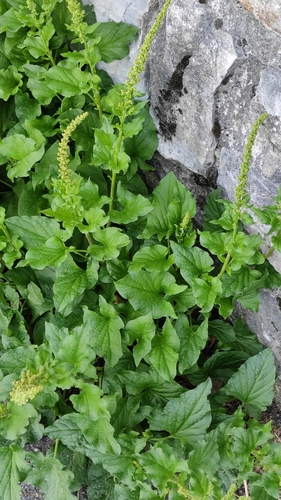
Good King Henry at a glance
| Type | Perennial vegetable, evergreen |
|---|---|
| Family | Amaranthaceae |
| Mature height | 30–60 cm (12–24 in) |
| Mature spread | 30–45 cm (12–18 in) |
| Spacing | 35 cm (14 in) centre to centre |
| Sun | Part sun to part shade, at least 4 h of direct sun a day |
| Water | Moderate; drought tolerance low, waterlogging tolerance none |
| Soil pH | 6–7.5 |
| Cold hardiness | About -30 °C (-22 °F) once established (roughly USDA zone 4) |
| Heat stress | Likely above about 30 °C (86 °F) |
| Flowering | from about May for 6–13 weeks (northern hemisphere; later in cold climates, earlier in warm ones) |
| Wind tolerance | Low |
| Pollinator value | None |
| Edible | Yes: young shoots (like asparagus), leaves (cooked, like spinach), flower spikes |
| Native to | Mountains of central and southern Europe |
| Common in gardens of | 🇬🇧 United Kingdom, 🇩🇪 Germany, 🇫🇷 France, 🇮🇹 Italy, 🇵🇱 Poland, 🇺🇸 United States |
Is Good King Henry toxic?
- People: mildly toxic
- Cats: mildly toxic
- Dogs: mildly toxic
- Parts: leaves, seeds
Contains oxalates and saponins: cook it and change the water; avoid large amounts with kidney problems.
If a child or pet may have eaten part of a plant, call a poison centre or vet straight away.
Companion planting: what to grow with Good King Henry
No well-documented helpful pairing. Group it with plants that like part sun to part shade and moderate water.
Questions about Good King Henry
- How far apart should I plant Good King Henry?
- About 35 cm (14 in) apart, centre to centre. A mature plant spreads 30–45 cm (12–18 in).
- Does Good King Henry need full sun?
- Part sun to part shade: at least 4 hours of direct sun a day.
- How much water does Good King Henry need?
- Moderate water. Drought tolerance is low and waterlogging tolerance none.
- How cold-hardy is Good King Henry?
- It tolerates about -30 °C (-22 °F) once established, roughly USDA zone 4.
- When does Good King Henry flower?
- From about May for 6–13 weeks (northern hemisphere; later in cold climates, earlier in warm ones).
- Is Good King Henry poisonous to cats and dogs?
- For cats it is mildly toxic; for dogs mildly toxic; for people mildly toxic. Contains oxalates and saponins: cook it and change the water; avoid large amounts with kidney problems.
- What grows well with Good King Henry?
- There is no well-documented companion pairing for Good King Henry. Group it with plants that like the same sun (part sun to part shade) and water (moderate).
Sources and evidence
Evidence grade B (B: extension service or peer-reviewed).
- Plants of the World Online (taxonomy, native range), Royal Botanic Gardens, Kew
- Plants For A Future database, PFAF
- RHS Find a Plant (plant profiles and growing guides), Royal Horticultural Society
Notes and assumptions
- Formerly Chenopodium bonus-henricus. A long-lived perennial spinach of medieval cottage gardens; needs rich soil and first cuts are best in the second year.
Reference values for planning, not horticultural, veterinary or medical advice. Varieties, soils and local climates differ: check with a local nursery or extension service.
Related plants
- Spinach Spinacia oleracea
- Swiss chard Beta vulgaris subsp. vulgaris (Cicla)
- Beetroot Beta vulgaris subsp. vulgaris
- Amaranth (leaf, callaloo) Amaranthus tricolor
- Quinoa Chenopodium quinoa
- Love-lies-bleeding (kiwicha) Amaranthus caudatus
- Epazote Dysphania ambrosioides
- Celosia (cockscomb) Celosia argentea