White horehound Marrubium vulgare
White horehound (Marrubium vulgare) is an evergreen perennial herb in the Lamiaceae family, native to Mediterranean, Europe and western to central Asia. It grows 30–60 cm (12–24 in) tall and 30–50 cm (12–20 in) wide, wants full sun and low water, and is hardy to about -25 °C (-13 °F). Space plants about 40 cm (16 in) apart.
Plan White horehound in your garden →
Free. Draw your beds, then watch it grow through the year in 2D and 3D.
White horehound at a glance
| Type | Perennial herb, evergreen |
|---|---|
| Family | Lamiaceae |
| Mature height | 30–60 cm (12–24 in) |
| Mature spread | 30–50 cm (12–20 in) |
| Spacing | 40 cm (16 in) centre to centre |
| Sun | Full sun, at least 6 h of direct sun a day |
| Water | Low; drought tolerance high, waterlogging tolerance none |
| Soil pH | 6–8.5 |
| Cold hardiness | About -25 °C (-13 °F) once established (roughly USDA zone 5) |
| Heat stress | Likely above about 38 °C (100 °F) |
| Flowering | from about June for 6–13 weeks (northern hemisphere; later in cold climates, earlier in warm ones) |
| Wind tolerance | Moderate |
| Pollinator value | High |
| Edible | Yes: leaves (bitter; horehound candy and cough drops) |
| Native to | Mediterranean, Europe and western to central Asia |
| Common in gardens of | 🇬🇧 United Kingdom, 🇺🇸 United States, 🇫🇷 France, 🇪🇸 Spain, 🇮🇹 Italy, 🇲🇦 Morocco, 🇹🇷 Turkey, 🇦🇷 Argentina, 🇦🇺 Australia |
| Invasive in | Australia (declared weed in several states), New Zealand, California, Argentina: check local rules before planting |
Is White horehound toxic?
- People: mildly toxic
- Cats: mildly toxic
- Dogs: mildly toxic
- Parts: leaves
Bitter; large amounts can upset the stomach and affect heart rhythm. Grazing animals avoid it.
If a child or pet may have eaten part of a plant, call a poison centre or vet straight away.
Companion planting: what to grow with White horehound
No well-documented helpful pairing. Group it with plants that like full sun and low water.
Questions about White horehound
- How far apart should I plant White horehound?
- About 40 cm (16 in) apart, centre to centre. A mature plant spreads 30–50 cm (12–20 in).
- Does White horehound need full sun?
- Full sun: at least 6 hours of direct sun a day.
- How much water does White horehound need?
- Low water. Drought tolerance is high and waterlogging tolerance none.
- How cold-hardy is White horehound?
- It tolerates about -25 °C (-13 °F) once established, roughly USDA zone 5.
- When does White horehound flower?
- From about June for 6–13 weeks (northern hemisphere; later in cold climates, earlier in warm ones).
- Is White horehound poisonous to cats and dogs?
- For cats it is mildly toxic; for dogs mildly toxic; for people mildly toxic. Bitter; large amounts can upset the stomach and affect heart rhythm. Grazing animals avoid it.
- What grows well with White horehound?
- There is no well-documented companion pairing for White horehound. Group it with plants that like the same sun (full sun) and water (low).
Sources and evidence
Evidence grade B (B: extension service or peer-reviewed).
- Plants of the World Online (taxonomy, native range), Royal Botanic Gardens, Kew
- CABI Invasive Species Compendium, CABI
- Herbal monographs (European Union herbal monographs and assessment reports), European Medicines Agency, Committee on Herbal Medicinal Products
Notes and assumptions
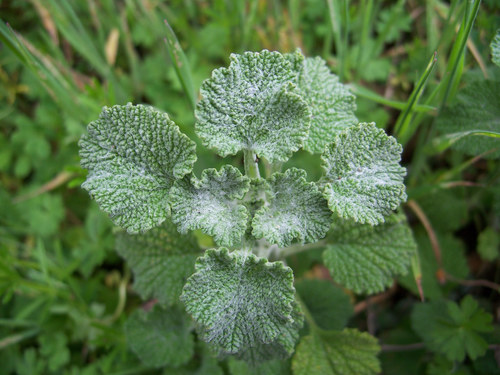
- Woolly, wrinkled grey leaves and white flower whorls whose burred calyces cling to wool and fur. A cough remedy since Roman times; the EMA lists it as a traditional herbal medicine. Seeds itself into dry pasture.
Reference values for planning, not horticultural, veterinary or medical advice. Varieties, soils and local climates differ: check with a local nursery or extension service.
Related plants
- Basil Ocimum basilicum
- Rosemary Salvia rosmarinus
- Thyme Thymus vulgaris
- Mint Mentha spicata
- English lavender Lavandula angustifolia
- Creeping thyme Thymus serpyllum
- Common sage Salvia officinalis
- Oregano Origanum vulgare