English lavender Lavandula angustifolia
English lavender (Lavandula angustifolia) is an evergreen perennial flowering plant in the Lamiaceae family. It grows 40–80 cm (16–31 in) tall and 50–90 cm (20–35 in) wide, wants full sun and low water, and is hardy to about -15 °C (5 °F). Space plants about 60 cm (24 in) apart.
Plan English lavender in your garden →
Free. Draw your beds, then watch it grow through the year in 2D and 3D.
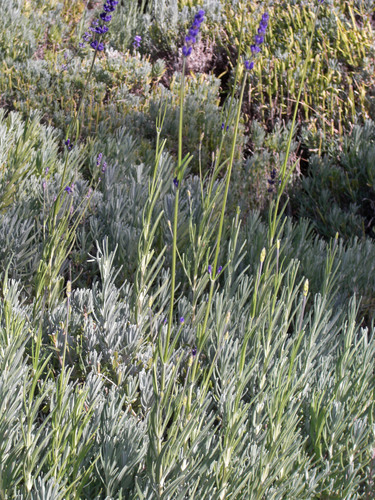
English lavender at a glance
| Type | Perennial flowering plant, evergreen |
|---|---|
| Family | Lamiaceae |
| Mature height | 40–80 cm (16–31 in) |
| Mature spread | 50–90 cm (20–35 in) |
| Spacing | 60 cm (24 in) centre to centre |
| Sun | Full sun, at least 6 h of direct sun a day |
| Water | Low; drought tolerance high, waterlogging tolerance none |
| Cold hardiness | About -15 °C (5 °F) once established (roughly USDA zone 7) |
| Heat stress | Likely above about 38 °C (100 °F) |
| Flowering | from about June for 4–9 weeks (northern hemisphere; later in cold climates, earlier in warm ones) |
| Wind tolerance | Moderate |
| Pollinator value | High |
| Edible | Yes: flowers |
| Common in gardens of | 🇺🇸 United States, 🇬🇧 United Kingdom, 🇫🇷 France, 🇩🇪 Germany, 🇦🇺 Australia, 🇿🇦 South Africa, 🇯🇵 Japan, 🇮🇹 Italy, 🇪🇸 Spain, 🇬🇷 Greece, 🇵🇹 Portugal, 🇮🇱 Israel, 🇦🇷 Argentina, 🇨🇱 Chile, 🇳🇱 Netherlands, 🇳🇿 New Zealand |
Is English lavender toxic?
- People: not known to be toxic
- Cats: mildly toxic
- Dogs: mildly toxic
- Parts: flowers, essential oil
Linalool and linalyl acetate can cause mild illness in cats and dogs.
If a child or pet may have eaten part of a plant, call a poison centre or vet straight away.
Companion planting: what to grow with English lavender
Good neighbours
- good With Cucumber: Pollinator-attracting flowers can increase insect visits for insect-pollinated crops nearby. Evidence C
Keep apart or take care
- caution With Acid-lovers: Acid-loving plants need pH 4.5–5.5, lavender prefers neutral to alkaline soil; one bed cannot suit both. Evidence B
See English lavender in a botanical garden
It grows in these sample gardens, which you can walk through in 3D:
- UC Botanical Garden, Berkeley (8 plants)
- Gardens by the Bay (8 plants)
- Brooklyn Botanic Garden (16 plants)
- The Butchart Gardens (10 plants)
- Kirstenbosch (6 plants)
- Kew: glasshouses and rock garden (10 plants)
- Riverside botanical garden (68 plants)
Questions about English lavender
- How far apart should I plant English lavender?
- About 60 cm (24 in) apart, centre to centre. A mature plant spreads 50–90 cm (20–35 in).
- Does English lavender need full sun?
- Full sun: at least 6 hours of direct sun a day.
- How much water does English lavender need?
- Low water. Drought tolerance is high and waterlogging tolerance none.
- How cold-hardy is English lavender?
- It tolerates about -15 °C (5 °F) once established, roughly USDA zone 7.
- When does English lavender flower?
- From about June for 4–9 weeks (northern hemisphere; later in cold climates, earlier in warm ones).
- Is English lavender poisonous to cats and dogs?
- For cats it is mildly toxic; for dogs mildly toxic; for people not known to be toxic. Linalool and linalyl acetate can cause mild illness in cats and dogs.
- What grows well with English lavender?
- Pollinator-attracting flowers can increase insect visits for insect-pollinated crops nearby.
Sources and evidence
Evidence grade C (C: plausible, mixed evidence).
- ASPCA Toxic and Non-Toxic Plant List, ASPCA
- FAO Irrigation and Drainage Paper 56 — Crop Evapotranspiration, FAO
- RHS Plant Finder, Royal Horticultural Society
- University extension gardening guides (general), Various land-grant university extensions
Notes and assumptions
- Typical garden-cultivar values; varieties differ.
- Needs sharp drainage.
Reference values for planning, not horticultural, veterinary or medical advice. Varieties, soils and local climates differ: check with a local nursery or extension service.
Related plants
- Basil Ocimum basilicum
- Rosemary Salvia rosmarinus
- Thyme Thymus vulgaris
- Mint Mentha spicata
- Creeping thyme Thymus serpyllum
- Common sage Salvia officinalis
- Oregano Origanum vulgare
- Thai basil Ocimum basilicum var. thyrsiflora