Cucumber Cucumis sativus
Cucumber (Cucumis sativus) is an annual vegetable in the Cucurbitaceae family. It grows 1.5–2 m (4.9–6.6 ft) tall and 40–80 cm (16–31 in) wide, wants full sun and high water, and is hardy to about 5 °C (41 °F). Space plants about 45 cm (18 in) apart.
Plan Cucumber in your garden →
Free. Draw your beds, then watch it grow through the year in 2D and 3D.
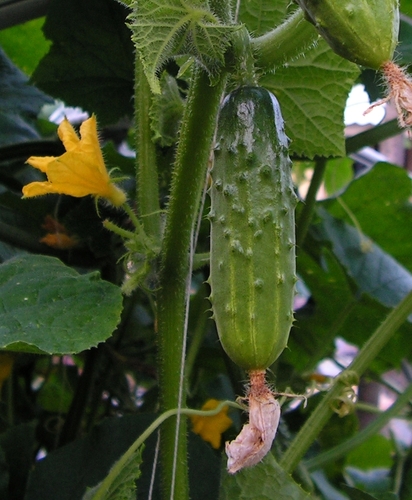
Cucumber at a glance
| Type | Annual vegetable |
|---|---|
| Family | Cucurbitaceae |
| Mature height | 1.5–2 m (4.9–6.6 ft) |
| Mature spread | 40–80 cm (16–31 in) |
| Spacing | 45 cm (18 in) centre to centre |
| Sun | Full sun, at least 6 h of direct sun a day |
| Water | High; drought tolerance none, waterlogging tolerance low |
| Cold hardiness | About 5 °C (41 °F) once established (roughly USDA zone 11) |
| Heat stress | Likely above about 32 °C (90 °F) |
| Flowering | about 5–7 weeks after planting, for 6–10 weeks |
| Days to maturity | About 65 days from planting |
| Wind tolerance | None |
| Pollinator value | Moderate |
| Edible | Yes: fruit |
| Common in gardens of | 🇺🇸 United States, 🇬🇧 United Kingdom, 🇨🇳 China, 🇯🇵 Japan, 🇩🇪 Germany, 🇷🇺 Russia, 🇫🇷 France, 🇳🇴 Norway, 🇿🇦 South Africa, 🇧🇷 Brazil, 🇵🇪 Peru, 🇲🇽 Mexico, 🇦🇺 Australia, 🇸🇬 Singapore, 🇹🇭 Thailand, 🇮🇳 India, 🇬🇷 Greece, 🇹🇷 Turkey, 🇪🇬 Egypt, 🇮🇱 Israel, 🇮🇷 Iran, 🇰🇷 South Korea, 🇻🇳 Vietnam, 🇵🇱 Poland |
Is Cucumber toxic?
- People: not known to be toxic
- Cats: not known to be toxic
- Dogs: not known to be toxic
Cucumber is non-toxic to people and pets.
If a child or pet may have eaten part of a plant, call a poison centre or vet straight away.
Companion planting: what to grow with Cucumber
Good neighbours
- good With English lavender: Pollinator-attracting flowers can increase insect visits for insect-pollinated crops nearby. Evidence C
Keep apart or take care
- caution With Zucchini (courgette): Cucurbits share powdery mildew, so disease can move between neighbouring plants. Evidence C
- caution With Cucurbits (squash family): Cucurbits share powdery mildew, cucumber beetles and mosaic viruses; good airflow and spacing reduce spread. Evidence C
Shared pests and diseases
- Powdery mildew: Powdery mildew spreads between cucurbits in warm, dry weather. Evidence C
Questions about Cucumber
- How far apart should I plant Cucumber?
- About 45 cm (18 in) apart, centre to centre. A mature plant spreads 40–80 cm (16–31 in).
- Does Cucumber need full sun?
- Full sun: at least 6 hours of direct sun a day.
- How much water does Cucumber need?
- High water. Drought tolerance is none and waterlogging tolerance low.
- How cold-hardy is Cucumber?
- It tolerates about 5 °C (41 °F) once established, roughly USDA zone 11. As an annual it is usually planted out after the last frost.
- When does Cucumber flower?
- About 5–7 weeks after planting, for 6–10 weeks.
- Is Cucumber poisonous to cats and dogs?
- For cats it is not known to be toxic; for dogs not known to be toxic; for people not known to be toxic. Cucumber is non-toxic to people and pets.
- What grows well with Cucumber?
- Pollinator-attracting flowers can increase insect visits for insect-pollinated crops nearby.
Sources and evidence
Evidence grade C (C: plausible, mixed evidence).
- ASPCA Toxic and Non-Toxic Plant List, ASPCA
- FAO Irrigation and Drainage Paper 56 — Crop Evapotranspiration, FAO
- RHS Plant Finder, Royal Horticultural Society
- University extension gardening guides (general), Various land-grant university extensions
Notes and assumptions
- Typical garden-cultivar values; varieties differ.
- Parthenocarpic varieties do not need pollinators.
Reference values for planning, not horticultural, veterinary or medical advice. Varieties, soils and local climates differ: check with a local nursery or extension service.
Related plants
- Zucchini (courgette) Cucurbita pepo
- Pumpkin Cucurbita maxima / C. pepo
- Watermelon Citrullus lanatus
- Muskmelon (cantaloupe) Cucumis melo
- Butternut squash Cucurbita moschata
- Bitter melon Momordica charantia
- Luffa (sponge gourd) Luffa aegyptiaca
- Bottle gourd Lagenaria siceraria