Christmas cactus (Thanksgiving cactus, crab cactus) Schlumbergera truncata
Christmas cactus (Thanksgiving cactus, crab cactus) (Schlumbergera truncata) is an evergreen perennial flowering plant in the Cactaceae family, native to Coastal mountain rainforest of south-eastern Brazil (Serra dos Órgãos, Rio de Janeiro), growing on trees and rocks. It grows 20–40 cm (8–16 in) tall and 30–60 cm (12–24 in) wide, wants part sun to part shade and moderate water, and is hardy to about 5 °C (41 °F). Space plants about 30 cm (12 in) apart.
Plan Christmas cactus (Thanksgiving cactus, crab cactus) in your garden →
Free. Draw your beds, then watch it grow through the year in 2D and 3D.
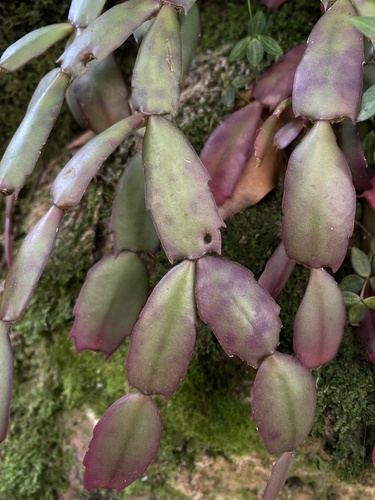
Christmas cactus (Thanksgiving cactus, crab cactus) at a glance
| Type | Perennial flowering plant, evergreen |
|---|---|
| Family | Cactaceae |
| Mature height | 20–40 cm (8–16 in) |
| Mature spread | 30–60 cm (12–24 in) |
| Spacing | 30 cm (12 in) centre to centre |
| Sun | Part sun to part shade, at least 3 h of direct sun a day |
| Water | Moderate; drought tolerance low, waterlogging tolerance none |
| Soil pH | 5.5–6.5 |
| Cold hardiness | About 5 °C (41 °F) once established (roughly USDA zone 11) |
| Heat stress | Likely above about 32 °C (90 °F) |
| Flowering | about 52–104 weeks after planting, for 4–7 weeks |
| Wind tolerance | None |
| Pollinator value | Moderate |
| Edible | Not grown as food |
| Native to | Coastal mountain rainforest of south-eastern Brazil (Serra dos Órgãos, Rio de Janeiro), growing on trees and rocks |
| Common in gardens of | 🇧🇷 Brazil, 🇺🇸 United States, 🇬🇧 United Kingdom, 🇩🇪 Germany, 🇳🇱 Netherlands, 🇵🇱 Poland, 🇯🇵 Japan, 🇦🇺 Australia |
Is Christmas cactus (Thanksgiving cactus, crab cactus) toxic?
- People: not known to be toxic
- Cats: not known to be toxic
- Dogs: not known to be toxic
Not poisonous to cats or dogs (ASPCA).
If a child or pet may have eaten part of a plant, call a poison centre or vet straight away.
Companion planting: what to grow with Christmas cactus (Thanksgiving cactus, crab cactus)
No well-documented helpful pairing. Group it with plants that like part sun to part shade and moderate water.
Questions about Christmas cactus (Thanksgiving cactus, crab cactus)
- How far apart should I plant Christmas cactus (Thanksgiving cactus, crab cactus)?
- About 30 cm (12 in) apart, centre to centre. A mature plant spreads 30–60 cm (12–24 in).
- Does Christmas cactus (Thanksgiving cactus, crab cactus) need full sun?
- Part sun to part shade: at least 3 hours of direct sun a day.
- How much water does Christmas cactus (Thanksgiving cactus, crab cactus) need?
- Moderate water. Drought tolerance is low and waterlogging tolerance none.
- How cold-hardy is Christmas cactus (Thanksgiving cactus, crab cactus)?
- It tolerates about 5 °C (41 °F) once established, roughly USDA zone 11.
- When does Christmas cactus (Thanksgiving cactus, crab cactus) flower?
- About 52–104 weeks after planting, for 4–7 weeks.
- Is Christmas cactus (Thanksgiving cactus, crab cactus) poisonous to cats and dogs?
- For cats it is not known to be toxic; for dogs not known to be toxic; for people not known to be toxic. Not poisonous to cats or dogs (ASPCA).
- What grows well with Christmas cactus (Thanksgiving cactus, crab cactus)?
- There is no well-documented companion pairing for Christmas cactus (Thanksgiving cactus, crab cactus). Group it with plants that like the same sun (part sun to part shade) and water (moderate).
Sources and evidence
Evidence grade A (A: strong evidence).
- Plants of the World Online (taxonomy, native range), Royal Botanic Gardens, Kew
- LLIFLE Encyclopedia of Cacti and Succulents, LLIFLE (Living Encyclopedia), Italy
- ASPCA Toxic and Non-Toxic Plant List, ASPCA
Notes and assumptions
- In frosty climates it is a classic pot plant for a bright windowsill, put outside in summer.
- A spineless forest cactus with arching chains of flat, toothed segments and hanging, layered flowers in pink, red, white or apricot at the tips in early winter. Unlike desert cacti it likes humus-rich compost, regular water and no hot sun; buds set after cool, long nights in autumn and drop if the plant is moved.
Reference values for planning, not horticultural, veterinary or medical advice. Varieties, soils and local climates differ: check with a local nursery or extension service.
Related plants
- Prickly pear (nopal) Opuntia ficus-indica
- Golden barrel cactus Echinocactus grusonii
- Saguaro Carnegiea gigantea
- Fishhook barrel cactus Ferocactus wislizeni
- Teddy-bear cholla Cylindropuntia bigelovii
- Engelmann's prickly pear Opuntia engelmannii
- Organ pipe cactus Stenocereus thurberi
- Mexican giant cardón Pachycereus pringlei