Saguaro Carnegiea gigantea
Saguaro (Carnegiea gigantea) is an evergreen perennial tree in the Cactaceae family, native to Sonoran Desert (Arizona and Sonora), bajadas below 1,200 m. It grows 6–14 m (20–46 ft) tall and 1–4 m (3.3–13 ft) wide, wants full sun and low water, and is hardy to about -7 °C (19 °F). Space plants about 4 m (13 ft) apart.
Plan Saguaro in your garden →
Free. Draw your beds, then watch it grow through the year in 2D and 3D.
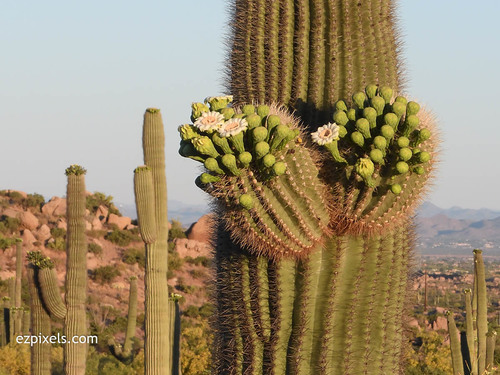
Saguaro at a glance
| Type | Perennial tree, evergreen |
|---|---|
| Family | Cactaceae |
| Mature height | 6–14 m (20–46 ft) |
| Mature spread | 1–4 m (3.3–13 ft) |
| Spacing | 4 m (13 ft) centre to centre |
| Sun | Full sun, at least 8 h of direct sun a day |
| Water | Low; drought tolerance high, waterlogging tolerance none |
| Soil pH | 6.5–8.5 |
| Cold hardiness | About -7 °C (19 °F) once established (roughly USDA zone 8) |
| Heat stress | Likely above about 50 °C (122 °F) |
| Wind tolerance | Moderate |
| Pollinator value | High |
| Edible | Yes: ripe fruit (harvested by the Tohono O'odham), seeds |
| Native to | Sonoran Desert (Arizona and Sonora), bajadas below 1,200 m |
| Common in gardens of | 🇺🇸 United States, 🇲🇽 Mexico |
Is Saguaro toxic?
- People: not known to be toxic
- Cats: not known to be toxic
- Dogs: not known to be toxic
Not toxic; spines injure.
If a child or pet may have eaten part of a plant, call a poison centre or vet straight away.
Companion planting: what to grow with Saguaro
No well-documented helpful pairing. Group it with plants that like full sun and low water.
See Saguaro in a botanical garden
It grows in these sample gardens, which you can walk through in 3D:
- The Huntington (1 plants)
- Desert Botanical Garden (10 plants)
- Nong Nooch Tropical Botanical Garden (2 plants)
- New York Botanical Garden (1 plants)
- Jardin botanique de Montréal (1 plants)
Questions about Saguaro
- How far apart should I plant Saguaro?
- About 4 m (13 ft) apart, centre to centre. A mature plant spreads 1–4 m (3.3–13 ft).
- Does Saguaro need full sun?
- Full sun: at least 8 hours of direct sun a day.
- How much water does Saguaro need?
- Low water. Drought tolerance is high and waterlogging tolerance none.
- How cold-hardy is Saguaro?
- It tolerates about -7 °C (19 °F) once established, roughly USDA zone 8.
- Is Saguaro poisonous to cats and dogs?
- For cats it is not known to be toxic; for dogs not known to be toxic; for people not known to be toxic. Not toxic; spines injure.
- What grows well with Saguaro?
- There is no well-documented companion pairing for Saguaro. Group it with plants that like the same sun (full sun) and water (low).
Sources and evidence
Evidence grade A (A: strong evidence).
- Desert Botanical Garden plant collections and trails, Desert Botanical Garden, Phoenix
- Plants of the national parks (Saguaro, Joshua Tree, Redwood), US National Park Service
- USDA PLANTS Database, USDA NRCS
Notes and assumptions
- Desert plant: needs sharp drainage and little summer water once established; rots in wet, heavy soil.
- Extremely slow: about 2–4 cm a year when young; first flowers at 35–70 years, arms at 50–100 years.
- Seedlings need a "nurse plant" (palo verde, ironwood) for shade.
- Protected by Arizona law: never take from the wild.
Reference values for planning, not horticultural, veterinary or medical advice. Varieties, soils and local climates differ: check with a local nursery or extension service.
Related plants
- Prickly pear (nopal) Opuntia ficus-indica
- Golden barrel cactus Echinocactus grusonii
- Fishhook barrel cactus Ferocactus wislizeni
- Teddy-bear cholla Cylindropuntia bigelovii
- Engelmann's prickly pear Opuntia engelmannii
- Organ pipe cactus Stenocereus thurberi
- Mexican giant cardón Pachycereus pringlei
- Dragon fruit (pitaya) Selenicereus undatus