Chilean bellflower (copihue) Lapageria rosea
Chilean bellflower (copihue) (Lapageria rosea) is an evergreen perennial flowering plant in the Philesiaceae family, native to Temperate rainforest of southern Chile (national flower of Chile). It grows 2–5 m (6.6–16 ft) tall and 1–2 m (3.3–6.6 ft) wide, wants shade and moderate water, and is hardy to about -5 °C (23 °F). Space plants about 1.2 m (3.9 ft) apart.
Plan Chilean bellflower (copihue) in your garden →
Free. Draw your beds, then watch it grow through the year in 2D and 3D.
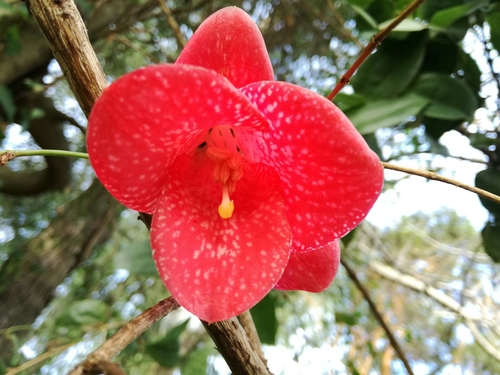
Chilean bellflower (copihue) at a glance
| Type | Perennial flowering plant, evergreen |
|---|---|
| Family | Philesiaceae |
| Mature height | 2–5 m (6.6–16 ft) |
| Mature spread | 1–2 m (3.3–6.6 ft) |
| Spacing | 1.2 m (3.9 ft) centre to centre |
| Sun | Shade, at least 2 h of direct sun a day |
| Water | Moderate; drought tolerance none, waterlogging tolerance none |
| Soil pH | 5–6.5 |
| Cold hardiness | About -5 °C (23 °F) once established (roughly USDA zone 9) |
| Heat stress | Likely above about 28 °C (82 °F) |
| Flowering | from about July for 9–17 weeks (northern hemisphere; later in cold climates, earlier in warm ones) |
| Wind tolerance | None |
| Pollinator value | Moderate |
| Edible | Yes: ripe berries |
| Native to | Temperate rainforest of southern Chile (national flower of Chile) |
| Common in gardens of | 🇬🇧 United Kingdom, 🇨🇱 Chile |
Is Chilean bellflower (copihue) toxic?
- People: not known to be toxic
- Cats: not well documented
- Dogs: not well documented
Berries are eaten in Chile; pet toxicity not documented.
If a child or pet may have eaten part of a plant, call a poison centre or vet straight away.
Companion planting: what to grow with Chilean bellflower (copihue)
No well-documented helpful pairing. Group it with plants that like shade and moderate water.
See Chilean bellflower (copihue) in a botanical garden
It grows in these sample gardens, which you can walk through in 3D:
- UC Botanical Garden, Berkeley (3 plants)
- Kew: glasshouses and rock garden (3 plants)
Questions about Chilean bellflower (copihue)
- How far apart should I plant Chilean bellflower (copihue)?
- About 1.2 m (3.9 ft) apart, centre to centre. A mature plant spreads 1–2 m (3.3–6.6 ft).
- Does Chilean bellflower (copihue) need full sun?
- Shade: at least 2 hours of direct sun a day.
- How much water does Chilean bellflower (copihue) need?
- Moderate water. Drought tolerance is none and waterlogging tolerance none.
- How cold-hardy is Chilean bellflower (copihue)?
- It tolerates about -5 °C (23 °F) once established, roughly USDA zone 9.
- When does Chilean bellflower (copihue) flower?
- From about July for 9–17 weeks (northern hemisphere; later in cold climates, earlier in warm ones).
- Is Chilean bellflower (copihue) poisonous to cats and dogs?
- For cats it is not well documented; for dogs not well documented; for people not known to be toxic. Berries are eaten in Chile; pet toxicity not documented.
- What grows well with Chilean bellflower (copihue)?
- There is no well-documented companion pairing for Chilean bellflower (copihue). Group it with plants that like the same sun (shade) and water (moderate).
Sources and evidence
Evidence grade B (B: extension service or peer-reviewed).
- Plants of the World Online (taxonomy, native range), Royal Botanic Gardens, Kew
- RHS Plant Finder, Royal Horticultural Society
Notes and assumptions
- Frost-tender to half-hardy: in cold-winter climates it needs a cool glasshouse (as in the Kew Temperate House).
- Twining climber for cool, moist, shady, acid conditions; waxy bells are hummingbird-pollinated.
Reference values for planning, not horticultural, veterinary or medical advice. Varieties, soils and local climates differ: check with a local nursery or extension service.
Related plants
- Sunflower Helianthus annuus
- French marigold Tagetes patula
- English lavender Lavandula angustifolia
- Zinnia Zinnia elegans
- Cosmos Cosmos bipinnatus
- Purple coneflower Echinacea purpurea
- Foxglove Digitalis purpurea
- Daffodil Narcissus pseudonarcissus