Blue vanda Vanda coerulea
Blue vanda (Vanda coerulea) is an evergreen perennial flowering plant in the Orchidaceae family, native to North-east India (Assam, Meghalaya, Manipur), Myanmar, northern Thailand and Yunnan. It grows 40 cm–1 m (16 in–3.3 ft) tall and 30–50 cm (12–20 in) wide, wants part sun to part shade and moderate water, and is hardy to about 8 °C (46 °F). Space plants about 40 cm (16 in) apart.
Plan Blue vanda in your garden →
Free. Draw your beds, then watch it grow through the year in 2D and 3D.
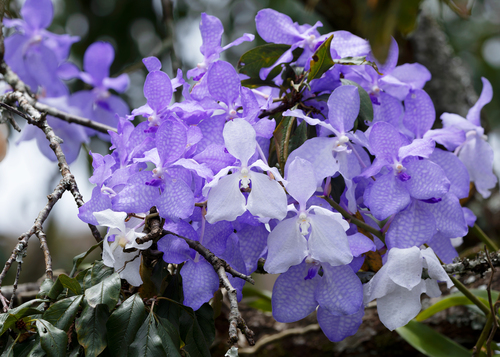
Blue vanda at a glance
| Type | Perennial flowering plant, evergreen |
|---|---|
| Family | Orchidaceae |
| Mature height | 40 cm–1 m (16 in–3.3 ft) |
| Mature spread | 30–50 cm (12–20 in) |
| Spacing | 40 cm (16 in) centre to centre |
| Sun | Part sun to part shade, at least 4 h of direct sun a day |
| Water | Moderate; drought tolerance low, waterlogging tolerance none |
| Soil pH | 5.5–6.5 |
| Cold hardiness | About 8 °C (46 °F) once established (roughly USDA zone 11) |
| Heat stress | Likely above about 32 °C (90 °F) |
| Flowering | about 209–313 weeks after planting, for 4–7 weeks |
| Wind tolerance | None |
| Pollinator value | Low |
| Edible | Not grown as food |
| Native to | North-east India (Assam, Meghalaya, Manipur), Myanmar, northern Thailand and Yunnan |
| Common in gardens of | 🇮🇳 India, 🇹🇭 Thailand, 🇸🇬 Singapore, 🇺🇸 United States, 🇬🇧 United Kingdom, 🇩🇪 Germany |
Is Blue vanda toxic?
- People: not known to be toxic
- Cats: not known to be toxic
- Dogs: not known to be toxic
Not poisonous to cats or dogs.
If a child or pet may have eaten part of a plant, call a poison centre or vet straight away.
Companion planting: what to grow with Blue vanda
No well-documented helpful pairing. Group it with plants that like part sun to part shade and moderate water.
Questions about Blue vanda
- How far apart should I plant Blue vanda?
- About 40 cm (16 in) apart, centre to centre. A mature plant spreads 30–50 cm (12–20 in).
- Does Blue vanda need full sun?
- Part sun to part shade: at least 4 hours of direct sun a day.
- How much water does Blue vanda need?
- Moderate water. Drought tolerance is low and waterlogging tolerance none.
- How cold-hardy is Blue vanda?
- It tolerates about 8 °C (46 °F) once established, roughly USDA zone 11.
- When does Blue vanda flower?
- About 209–313 weeks after planting, for 4–7 weeks.
- Is Blue vanda poisonous to cats and dogs?
- For cats it is not known to be toxic; for dogs not known to be toxic; for people not known to be toxic. Not poisonous to cats or dogs.
- What grows well with Blue vanda?
- There is no well-documented companion pairing for Blue vanda. Group it with plants that like the same sun (part sun to part shade) and water (moderate).
Sources and evidence
Evidence grade A (A: strong evidence).
- Plants of the World Online (taxonomy, native range), Royal Botanic Gardens, Kew
- IUCN Red List of Threatened Species, IUCN
- Flora & Fauna Web, National Parks Board, Singapore
Notes and assumptions
- A tropical plant: outdoors only in frost-free, humid climates; elsewhere a houseplant for bright, indirect light that likes warmth and humidity and hates cold draughts.
- One of the very few truly blue orchids: tall stems of flat, lilac-blue flowers chequered with darker blue, in autumn. It grows on trees in cool hill forests with bright light and moving air, its roots hanging free. Heavily collected in the past; listed on CITES Appendix I, so only nursery-raised plants are traded.
Reference values for planning, not horticultural, veterinary or medical advice. Varieties, soils and local climates differ: check with a local nursery or extension service.
Related plants
- Tiger orchid Grammatophyllum speciosum
- Vanda Miss Joaquim Papilionanthe Miss Joaquim
- Moon orchid (moth orchid) Phalaenopsis amabilis
- Pigeon orchid Dendrobium crumenatum
- Philippine ground orchid Spathoglottis plicata
- Bamboo orchid Arundina graminifolia
- Veitch's masdevallia Masdevallia veitchiana
- Crimson cattleya Cattleya labiata