Veitch's masdevallia Masdevallia veitchiana
Veitch's masdevallia (Masdevallia veitchiana) is an evergreen perennial flowering plant in the Orchidaceae family, native to Peruvian Andes around Cusco and Machu Picchu (rock crevices among grass, about 2,200–4,000 m). It grows 20–40 cm (8–16 in) tall and 20–30 cm (8–12 in) wide, wants part sun to part shade and high water, and is hardy to about 2 °C (36 °F). Space plants about 20 cm (8 in) apart.
Plan Veitch's masdevallia in your garden →
Free. Draw your beds, then watch it grow through the year in 2D and 3D.
Veitch's masdevallia at a glance
| Type | Perennial flowering plant, evergreen |
|---|---|
| Family | Orchidaceae |
| Mature height | 20–40 cm (8–16 in) |
| Mature spread | 20–30 cm (8–12 in) |
| Spacing | 20 cm (8 in) centre to centre |
| Sun | Part sun to part shade, at least 3 h of direct sun a day |
| Water | High; drought tolerance none, waterlogging tolerance none |
| Soil pH | 5–6.5 |
| Cold hardiness | About 2 °C (36 °F) once established (roughly USDA zone 10) |
| Heat stress | Likely above about 26 °C (79 °F) |
| Flowering | from about April for 4–9 weeks (northern hemisphere; later in cold climates, earlier in warm ones) |
| Wind tolerance | None |
| Pollinator value | Low |
| Edible | Not grown as food |
| Native to | Peruvian Andes around Cusco and Machu Picchu (rock crevices among grass, about 2,200–4,000 m) |
| Common in gardens of | 🇵🇪 Peru, 🇸🇬 Singapore |
Is Veitch's masdevallia toxic?
- People: not known to be toxic
- Cats: not known to be toxic
- Dogs: not known to be toxic
Orchids are generally listed as non-toxic; no data for this species.
If a child or pet may have eaten part of a plant, call a poison centre or vet straight away.
Companion planting: what to grow with Veitch's masdevallia
No well-documented helpful pairing. Group it with plants that like part sun to part shade and high water.
See Veitch's masdevallia in a botanical garden
It grows in this sample garden, which you can walk through in 3D:
- Gardens by the Bay (12 plants)
Questions about Veitch's masdevallia
- How far apart should I plant Veitch's masdevallia?
- About 20 cm (8 in) apart, centre to centre. A mature plant spreads 20–30 cm (8–12 in).
- Does Veitch's masdevallia need full sun?
- Part sun to part shade: at least 3 hours of direct sun a day.
- How much water does Veitch's masdevallia need?
- High water. Drought tolerance is none and waterlogging tolerance none.
- How cold-hardy is Veitch's masdevallia?
- It tolerates about 2 °C (36 °F) once established, roughly USDA zone 10.
- When does Veitch's masdevallia flower?
- From about April for 4–9 weeks (northern hemisphere; later in cold climates, earlier in warm ones).
- Is Veitch's masdevallia poisonous to cats and dogs?
- For cats it is not known to be toxic; for dogs not known to be toxic; for people not known to be toxic. Orchids are generally listed as non-toxic; no data for this species.
- What grows well with Veitch's masdevallia?
- There is no well-documented companion pairing for Veitch's masdevallia. Group it with plants that like the same sun (part sun to part shade) and water (high).
Sources and evidence
Evidence grade B (B: extension service or peer-reviewed).
- Plants of the World Online (taxonomy, native range), Royal Botanic Gardens, Kew
- Cloud Forest conservatory (Cloud Mountain, cool-moist montane climate), Gardens by the Bay
Notes and assumptions
- Tropical montane (cloud forest, about 1,000–3,000 m): needs cool, constantly humid air. In the hot lowlands it is grown in a cooled conservatory (as in the Cloud Forest dome, kept near 23–25 °C).
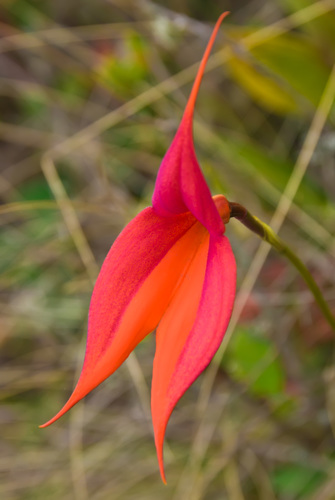
- Three fused, triangular orange sepals covered in tiny iridescent purple hairs; the cool-growing "king of the masdevallias".
Reference values for planning, not horticultural, veterinary or medical advice. Varieties, soils and local climates differ: check with a local nursery or extension service.
Related plants
- Tiger orchid Grammatophyllum speciosum
- Vanda Miss Joaquim Papilionanthe Miss Joaquim
- Moon orchid (moth orchid) Phalaenopsis amabilis
- Pigeon orchid Dendrobium crumenatum
- Philippine ground orchid Spathoglottis plicata
- Bamboo orchid Arundina graminifolia
- Crimson cattleya Cattleya labiata
- Red disa (Pride of Table Mountain) Disa uniflora