Bishop’s cap cactus Astrophytum myriostigma
Bishop’s cap cactus (Astrophytum myriostigma) is an evergreen perennial groundcover in the Cactaceae family, native to Chihuahuan Desert of north-eastern and central Mexico. It grows 10–60 cm (4–24 in) tall and 10–20 cm (4–8 in) wide, wants full sun and low water, and is hardy to about -2 °C (28 °F). Space plants about 15 cm (6 in) apart.
Plan Bishop’s cap cactus in your garden →
Free. Draw your beds, then watch it grow through the year in 2D and 3D.
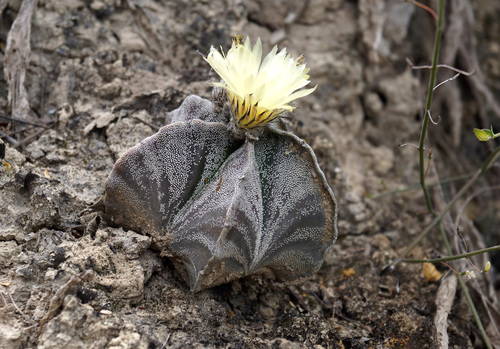
Bishop’s cap cactus at a glance
| Type | Perennial groundcover, evergreen |
|---|---|
| Family | Cactaceae |
| Mature height | 10–60 cm (4–24 in) |
| Mature spread | 10–20 cm (4–8 in) |
| Spacing | 15 cm (6 in) centre to centre |
| Sun | Full sun, at least 6 h of direct sun a day |
| Water | Low; drought tolerance high, waterlogging tolerance none |
| Soil pH | 7–8.5 |
| Cold hardiness | About -2 °C (28 °F) once established (roughly USDA zone 9) |
| Heat stress | Likely above about 42 °C (108 °F) |
| Flowering | about 156–261 weeks after planting, for 4–9 weeks |
| Wind tolerance | Low |
| Pollinator value | Moderate |
| Edible | Not grown as food |
| Native to | Chihuahuan Desert of north-eastern and central Mexico |
| Common in gardens of | 🇲🇽 Mexico, 🇺🇸 United States, 🇬🇧 United Kingdom, 🇩🇪 Germany, 🇯🇵 Japan, 🇰🇷 South Korea |
Is Bishop’s cap cactus toxic?
- People: not known to be toxic
- Cats: not known to be toxic
- Dogs: not known to be toxic
Not poisonous; spineless.
If a child or pet may have eaten part of a plant, call a poison centre or vet straight away.
Companion planting: what to grow with Bishop’s cap cactus
No well-documented helpful pairing. Group it with plants that like full sun and low water.
Questions about Bishop’s cap cactus
- How far apart should I plant Bishop’s cap cactus?
- About 15 cm (6 in) apart, centre to centre. A mature plant spreads 10–20 cm (4–8 in).
- Does Bishop’s cap cactus need full sun?
- Full sun: at least 6 hours of direct sun a day.
- How much water does Bishop’s cap cactus need?
- Low water. Drought tolerance is high and waterlogging tolerance none.
- How cold-hardy is Bishop’s cap cactus?
- It tolerates about -2 °C (28 °F) once established, roughly USDA zone 9.
- When does Bishop’s cap cactus flower?
- About 156–261 weeks after planting, for 4–9 weeks.
- Is Bishop’s cap cactus poisonous to cats and dogs?
- For cats it is not known to be toxic; for dogs not known to be toxic; for people not known to be toxic. Not poisonous; spineless.
- What grows well with Bishop’s cap cactus?
- There is no well-documented companion pairing for Bishop’s cap cactus. Group it with plants that like the same sun (full sun) and water (low).
Sources and evidence
Evidence grade A (A: strong evidence).
- Plants of the World Online (taxonomy, native range), Royal Botanic Gardens, Kew
- LLIFLE Encyclopedia of Cacti and Succulents, LLIFLE (Living Encyclopedia), Italy
Notes and assumptions
- A plant of dry, sunny places: grow it in gritty, free-draining soil and water deeply but rarely; cold and wet together kill it faster than frost or drought.
- In frosty climates it is a classic pot plant for a bright windowsill, put outside in summer.
- A spineless, star-shaped cactus, usually with five sharp ribs, freckled with tiny white woolly scales like a bishop’s mitre seen from above; glossy yellow flowers appear from the crown in summer.
Reference values for planning, not horticultural, veterinary or medical advice. Varieties, soils and local climates differ: check with a local nursery or extension service.
Related plants
- Prickly pear (nopal) Opuntia ficus-indica
- Golden barrel cactus Echinocactus grusonii
- Saguaro Carnegiea gigantea
- Fishhook barrel cactus Ferocactus wislizeni
- Teddy-bear cholla Cylindropuntia bigelovii
- Engelmann's prickly pear Opuntia engelmannii
- Organ pipe cactus Stenocereus thurberi
- Mexican giant cardón Pachycereus pringlei