Agrimony (church steeples) Agrimonia eupatoria
Agrimony (church steeples) (Agrimonia eupatoria) is an evergreen perennial flowering plant in the Rosaceae family, native to Europe, western Asia and North Africa (grassland and hedge banks). It grows 30–90 cm (12–35 in) tall and 30–45 cm (12–18 in) wide, wants full sun and low water, and is hardy to about -30 °C (-22 °F). Space plants about 35 cm (14 in) apart.
Plan Agrimony (church steeples) in your garden →
Free. Draw your beds, then watch it grow through the year in 2D and 3D.
Agrimony (church steeples) at a glance
| Type | Perennial flowering plant, evergreen |
|---|---|
| Family | Rosaceae |
| Mature height | 30–90 cm (12–35 in) |
| Mature spread | 30–45 cm (12–18 in) |
| Spacing | 35 cm (14 in) centre to centre |
| Sun | Full sun, at least 5 h of direct sun a day |
| Water | Low; drought tolerance moderate, waterlogging tolerance none |
| Soil pH | 6–8 |
| Cold hardiness | About -30 °C (-22 °F) once established (roughly USDA zone 4) |
| Heat stress | Likely above about 32 °C (90 °F) |
| Flowering | from about June for 6–11 weeks (northern hemisphere; later in cold climates, earlier in warm ones) |
| Wind tolerance | Low |
| Pollinator value | Moderate |
| Edible | Yes: leaves (herbal tea) |
| Native to | Europe, western Asia and North Africa (grassland and hedge banks) |
| Common in gardens of | 🇬🇧 United Kingdom, 🇩🇪 Germany, 🇫🇷 France, 🇵🇱 Poland, 🇮🇹 Italy, 🇹🇷 Turkey, 🇺🇸 United States |
Is Agrimony (church steeples) toxic?
- People: not known to be toxic
- Cats: not known to be toxic
- Dogs: not known to be toxic
No toxicity reported in ASPCA or standard poison references.
If a child or pet may have eaten part of a plant, call a poison centre or vet straight away.
Companion planting: what to grow with Agrimony (church steeples)
Good neighbours
- good With Garlic chives: Gardeners plant garlic chives among roses to deter aphids and black spot; the evidence is weak and mostly anecdotal. Evidence D
Questions about Agrimony (church steeples)
- How far apart should I plant Agrimony (church steeples)?
- About 35 cm (14 in) apart, centre to centre. A mature plant spreads 30–45 cm (12–18 in).
- Does Agrimony (church steeples) need full sun?
- Full sun: at least 5 hours of direct sun a day.
- How much water does Agrimony (church steeples) need?
- Low water. Drought tolerance is moderate and waterlogging tolerance none.
- How cold-hardy is Agrimony (church steeples)?
- It tolerates about -30 °C (-22 °F) once established, roughly USDA zone 4.
- When does Agrimony (church steeples) flower?
- From about June for 6–11 weeks (northern hemisphere; later in cold climates, earlier in warm ones).
- Is Agrimony (church steeples) poisonous to cats and dogs?
- For cats it is not known to be toxic; for dogs not known to be toxic; for people not known to be toxic. No toxicity reported in ASPCA or standard poison references.
- What grows well with Agrimony (church steeples)?
- Gardeners plant garlic chives among roses to deter aphids and black spot; the evidence is weak and mostly anecdotal.
Sources and evidence
Evidence grade B (B: extension service or peer-reviewed).
- Plants of the World Online (taxonomy, native range), Royal Botanic Gardens, Kew
- Wildflowers and meadows, Plantlife (UK)
- Herbal monographs (European Union herbal monographs and assessment reports), European Medicines Agency, Committee on Herbal Medicinal Products
Notes and assumptions
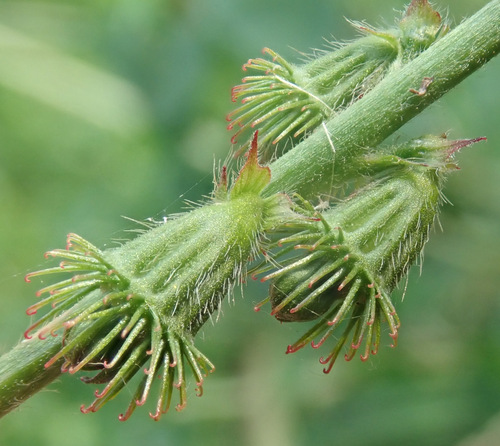
- Slender spires of small yellow flowers above hairy, pinnate leaves; the hooked seed burrs cling to clothes. An Anglo-Saxon wound herb; the EMA lists the herb as a traditional remedy for mild diarrhoea.
Reference values for planning, not horticultural, veterinary or medical advice. Varieties, soils and local climates differ: check with a local nursery or extension service.
Related plants
- Strawberry Fragaria x ananassa
- Dwarf apple tree Malus domestica
- Common ninebark Physocarpus opulifolius
- Serviceberry Amelanchier canadensis
- Raspberry Rubus idaeus
- Blackberry Rubus fruticosus agg.
- Garden rose Rosa x hybrida
- Japanese flowering cherry Prunus serrulata