Common ninebark Physocarpus opulifolius
Common ninebark (Physocarpus opulifolius) is a deciduous perennial shrub in the Rosaceae family. It grows 1.5–3 m (4.9–10 ft) tall and 1.5–2.5 m (4.9–8.2 ft) wide, wants full sun and low water, and is hardy to about -35 °C (-31 °F). Space plants about 1.8 m (5.9 ft) apart.
Plan Common ninebark in your garden →
Free. Draw your beds, then watch it grow through the year in 2D and 3D.
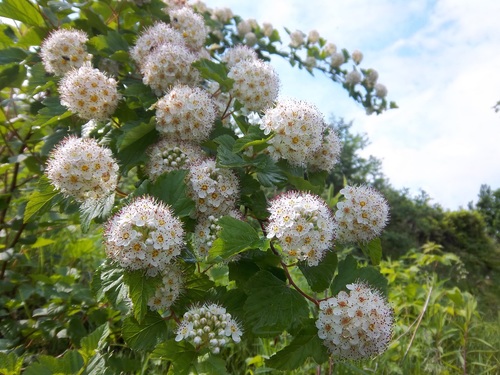
Common ninebark at a glance
| Type | Perennial shrub, deciduous |
|---|---|
| Family | Rosaceae |
| Mature height | 1.5–3 m (4.9–10 ft) |
| Mature spread | 1.5–2.5 m (4.9–8.2 ft) |
| Spacing | 1.8 m (5.9 ft) centre to centre |
| Sun | Full sun, at least 5 h of direct sun a day |
| Water | Low; drought tolerance moderate, waterlogging tolerance low |
| Cold hardiness | About -35 °C (-31 °F) once established (roughly USDA zone 3) |
| Heat stress | Likely above about 35 °C (95 °F) |
| Flowering | from about May for 2–4 weeks (northern hemisphere; later in cold climates, earlier in warm ones) |
| Wind tolerance | Moderate |
| Pollinator value | Moderate |
| Edible | Not grown as food |
| Common in gardens of | 🇺🇸 United States, 🇩🇪 Germany, 🇷🇺 Russia |
Is Common ninebark toxic?
- People: not known to be toxic
- Cats: not well documented
- Dogs: not well documented
No well-documented toxicity; treat as not for eating.
If a child or pet may have eaten part of a plant, call a poison centre or vet straight away.
Companion planting: what to grow with Common ninebark
Good neighbours
- good With Garlic chives: Gardeners plant garlic chives among roses to deter aphids and black spot; the evidence is weak and mostly anecdotal. Evidence D
Shared pests and diseases
- Fire blight: Fire blight bacteria are carried by bees and rain between apples, pears, quince, hawthorn, cotoneaster and firethorn. Evidence B
Questions about Common ninebark
- How far apart should I plant Common ninebark?
- About 1.8 m (5.9 ft) apart, centre to centre. A mature plant spreads 1.5–2.5 m (4.9–8.2 ft).
- Does Common ninebark need full sun?
- Full sun: at least 5 hours of direct sun a day.
- How much water does Common ninebark need?
- Low water. Drought tolerance is moderate and waterlogging tolerance low.
- How cold-hardy is Common ninebark?
- It tolerates about -35 °C (-31 °F) once established, roughly USDA zone 3.
- When does Common ninebark flower?
- From about May for 2–4 weeks (northern hemisphere; later in cold climates, earlier in warm ones).
- Is Common ninebark poisonous to cats and dogs?
- For cats it is not well documented; for dogs not well documented; for people not known to be toxic. No well-documented toxicity; treat as not for eating.
- What grows well with Common ninebark?
- Gardeners plant garlic chives among roses to deter aphids and black spot; the evidence is weak and mostly anecdotal.
Sources and evidence
Evidence grade C (C: plausible, mixed evidence).
- ASPCA Toxic and Non-Toxic Plant List, ASPCA
- FAO Irrigation and Drainage Paper 56 — Crop Evapotranspiration, FAO
- RHS Plant Finder, Royal Horticultural Society
- University extension gardening guides (general), Various land-grant university extensions
Notes and assumptions
- Typical garden-cultivar values; varieties differ.
- Purple-leaved cultivars shown; native form is green.
Reference values for planning, not horticultural, veterinary or medical advice. Varieties, soils and local climates differ: check with a local nursery or extension service.
Related plants
- Strawberry Fragaria x ananassa
- Dwarf apple tree Malus domestica
- Serviceberry Amelanchier canadensis
- Raspberry Rubus idaeus
- Blackberry Rubus fruticosus agg.
- Garden rose Rosa x hybrida
- Japanese flowering cherry Prunus serrulata
- Pear Pyrus communis