White ginger lily Hedychium coronarium
White ginger lily (Hedychium coronarium) is an evergreen perennial flowering plant in the Zingiberaceae family, native to Himalaya, southern China and Indochina (stream banks and wet forest edges). It grows 1.2–2 m (3.9–6.6 ft) tall and 80 cm–1.2 m (31 in–3.9 ft) wide, wants part sun to part shade and high water, and is hardy to about -5 °C (23 °F). Space plants about 80 cm (31 in) apart.
Plan White ginger lily in your garden →
Free. Draw your beds, then watch it grow through the year in 2D and 3D.
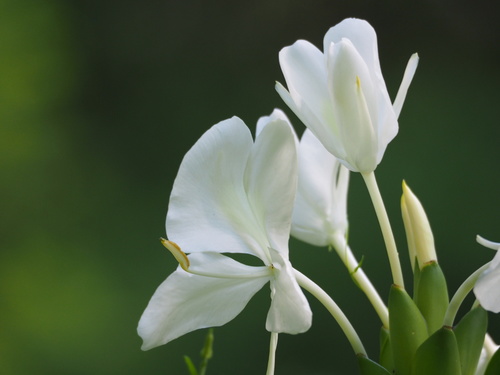
White ginger lily at a glance
| Type | Perennial flowering plant, evergreen |
|---|---|
| Family | Zingiberaceae |
| Mature height | 1.2–2 m (3.9–6.6 ft) |
| Mature spread | 80 cm–1.2 m (31 in–3.9 ft) |
| Spacing | 80 cm (31 in) centre to centre |
| Sun | Part sun to part shade, at least 4 h of direct sun a day |
| Water | High; drought tolerance none, waterlogging tolerance moderate |
| Soil pH | 5–7 |
| Cold hardiness | About -5 °C (23 °F) once established (roughly USDA zone 9) |
| Heat stress | Likely above about 36 °C (97 °F) |
| Flowering | from about June for 13–21 weeks (northern hemisphere; later in cold climates, earlier in warm ones) |
| Wind tolerance | Low |
| Pollinator value | Moderate |
| Edible | Not grown as food |
| Native to | Himalaya, southern China and Indochina (stream banks and wet forest edges) |
| Common in gardens of | 🇨🇳 China, 🇹🇭 Thailand, 🇸🇬 Singapore, 🇧🇷 Brazil, 🇿🇦 South Africa |
| Invasive in | Brazil, Hawaii, South Africa, New Zealand: check local rules before planting |
Is White ginger lily toxic?
- People: not known to be toxic
- Cats: not known to be toxic
- Dogs: not known to be toxic
No toxicity reported in ASPCA or standard poison references.
If a child or pet may have eaten part of a plant, call a poison centre or vet straight away.
Companion planting: what to grow with White ginger lily
No well-documented helpful pairing. Group it with plants that like part sun to part shade and high water.
See White ginger lily in a botanical garden
It grows in this sample garden, which you can walk through in 3D:
- Singapore Botanic Gardens (7 plants)
Questions about White ginger lily
- How far apart should I plant White ginger lily?
- About 80 cm (31 in) apart, centre to centre. A mature plant spreads 80 cm–1.2 m (31 in–3.9 ft).
- Does White ginger lily need full sun?
- Part sun to part shade: at least 4 hours of direct sun a day.
- How much water does White ginger lily need?
- High water. Drought tolerance is none and waterlogging tolerance moderate.
- How cold-hardy is White ginger lily?
- It tolerates about -5 °C (23 °F) once established, roughly USDA zone 9.
- When does White ginger lily flower?
- From about June for 13–21 weeks (northern hemisphere; later in cold climates, earlier in warm ones).
- Is White ginger lily poisonous to cats and dogs?
- For cats it is not known to be toxic; for dogs not known to be toxic; for people not known to be toxic. No toxicity reported in ASPCA or standard poison references.
- What grows well with White ginger lily?
- There is no well-documented companion pairing for White ginger lily. Group it with plants that like the same sun (part sun to part shade) and water (high).
Sources and evidence
Evidence grade B (B: extension service or peer-reviewed).
- Plants of the World Online (taxonomy, native range), Royal Botanic Gardens, Kew
- CABI Invasive Species Compendium, CABI
- Missouri Botanical Garden Plant Finder, Missouri Botanical Garden
Notes and assumptions
- Subtropical: the rhizome survives about −5 °C under mulch; the shoots die back in frost.
- Butterfly-like, very fragrant white flowers open at dusk from a cone of green bracts. Invasive in wetlands of several countries: do not plant near wild streams there.
- Typical garden-form values; cultivars and local conditions differ.
Reference values for planning, not horticultural, veterinary or medical advice. Varieties, soils and local climates differ: check with a local nursery or extension service.
Related plants
- Ginger Zingiber officinale
- Turmeric Curcuma longa
- Galangal Alpinia galanga
- Torch ginger Etlingera elatior
- Shell ginger Alpinia zerumbet
- Red ginger Alpinia purpurata
- Beehive ginger Zingiber spectabile
- Siam tulip Curcuma alismatifolia