Beehive ginger Zingiber spectabile
Beehive ginger (Zingiber spectabile) is an evergreen perennial flowering plant in the Zingiberaceae family, native to Peninsular Malaysia and southern Thailand (rainforest understorey). It grows 1.5–3 m (4.9–10 ft) tall and 1–2 m (3.3–6.6 ft) wide, wants part sun to part shade and high water, and is hardy to about 10 °C (50 °F). Space plants about 1.2 m (3.9 ft) apart.
Plan Beehive ginger in your garden →
Free. Draw your beds, then watch it grow through the year in 2D and 3D.
Beehive ginger at a glance
| Type | Perennial flowering plant, evergreen |
|---|---|
| Family | Zingiberaceae |
| Mature height | 1.5–3 m (4.9–10 ft) |
| Mature spread | 1–2 m (3.3–6.6 ft) |
| Spacing | 1.2 m (3.9 ft) centre to centre |
| Sun | Part sun to part shade, at least 3 h of direct sun a day |
| Water | High; drought tolerance none, waterlogging tolerance low |
| Soil pH | 5–6.8 |
| Cold hardiness | About 10 °C (50 °F) once established (roughly USDA zone 12) |
| Heat stress | Likely above about 35 °C (95 °F) |
| Flowering | from about May for 13–21 weeks (northern hemisphere; later in cold climates, earlier in warm ones) |
| Wind tolerance | Low |
| Pollinator value | Moderate |
| Edible | Not grown as food |
| Native to | Peninsular Malaysia and southern Thailand (rainforest understorey) |
| Common in gardens of | 🇸🇬 Singapore, 🇹🇭 Thailand |
Is Beehive ginger toxic?
- People: not known to be toxic
- Cats: not known to be toxic
- Dogs: not known to be toxic
No toxicity reported in ASPCA or standard poison references.
If a child or pet may have eaten part of a plant, call a poison centre or vet straight away.
Companion planting: what to grow with Beehive ginger
No well-documented helpful pairing. Group it with plants that like part sun to part shade and high water.
See Beehive ginger in a botanical garden
It grows in this sample garden, which you can walk through in 3D:
- Singapore Botanic Gardens (4 plants)
Questions about Beehive ginger
- How far apart should I plant Beehive ginger?
- About 1.2 m (3.9 ft) apart, centre to centre. A mature plant spreads 1–2 m (3.3–6.6 ft).
- Does Beehive ginger need full sun?
- Part sun to part shade: at least 3 hours of direct sun a day.
- How much water does Beehive ginger need?
- High water. Drought tolerance is none and waterlogging tolerance low.
- How cold-hardy is Beehive ginger?
- It tolerates about 10 °C (50 °F) once established, roughly USDA zone 12.
- When does Beehive ginger flower?
- From about May for 13–21 weeks (northern hemisphere; later in cold climates, earlier in warm ones).
- Is Beehive ginger poisonous to cats and dogs?
- For cats it is not known to be toxic; for dogs not known to be toxic; for people not known to be toxic. No toxicity reported in ASPCA or standard poison references.
- What grows well with Beehive ginger?
- There is no well-documented companion pairing for Beehive ginger. Group it with plants that like the same sun (part sun to part shade) and water (high).
Sources and evidence
Evidence grade B (B: extension service or peer-reviewed).
- Plants of the World Online (taxonomy, native range), Royal Botanic Gardens, Kew
- Flora & Fauna Web, National Parks Board, Singapore
- UF/IFAS Extension tropical and subtropical fruit and landscape publications, University of Florida
Notes and assumptions
- Tropical lowland plant: outdoors only where it never frosts (as in Singapore); elsewhere it needs a heated glasshouse.
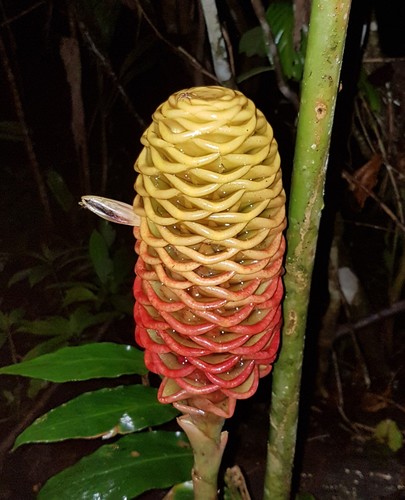
- Beehive-shaped cones of cupped bracts, yellow turning red, rise on short stalks near the ground; small cream and purple flowers peep out.
- Typical garden-form values; cultivars and local conditions differ.
Reference values for planning, not horticultural, veterinary or medical advice. Varieties, soils and local climates differ: check with a local nursery or extension service.
Related plants
- Ginger Zingiber officinale
- Turmeric Curcuma longa
- Galangal Alpinia galanga
- Torch ginger Etlingera elatior
- Shell ginger Alpinia zerumbet
- Red ginger Alpinia purpurata
- Siam tulip Curcuma alismatifolia
- White ginger lily Hedychium coronarium