Toyon (California holly) Heteromeles arbutifolia
Toyon (California holly) (Heteromeles arbutifolia) is an evergreen perennial shrub in the Rosaceae family, native to California chaparral and oak woodland. It grows 2.5–5 m (8.2–16 ft) tall and 2.5–4 m (8.2–13 ft) wide, wants full sun and low water, and is hardy to about -10 °C (14 °F). Space plants about 3 m (10 ft) apart.
Plan Toyon (California holly) in your garden →
Free. Draw your beds, then watch it grow through the year in 2D and 3D.
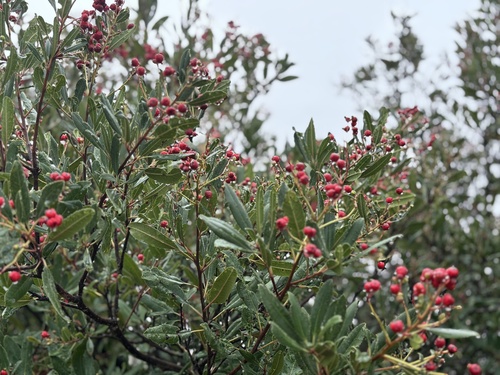
Toyon (California holly) at a glance
| Type | Perennial shrub, evergreen |
|---|---|
| Family | Rosaceae |
| Mature height | 2.5–5 m (8.2–16 ft) |
| Mature spread | 2.5–4 m (8.2–13 ft) |
| Spacing | 3 m (10 ft) centre to centre |
| Sun | Full sun, at least 5 h of direct sun a day |
| Water | Low; drought tolerance high, waterlogging tolerance none |
| Soil pH | 5.5–8 |
| Cold hardiness | About -10 °C (14 °F) once established (roughly USDA zone 8) |
| Heat stress | Likely above about 40 °C (104 °F) |
| Flowering | from about June for 4–6 weeks (northern hemisphere; later in cold climates, earlier in warm ones) |
| Wind tolerance | Moderate |
| Pollinator value | High |
| Edible | Yes: berries (cooked) |
| Native to | California chaparral and oak woodland |
| Common in gardens of | 🇺🇸 United States |
Is Toyon (California holly) toxic?
- People: mildly toxic
- Cats: mildly toxic
- Dogs: mildly toxic
- Parts: leaves, raw berries
Cyanogenic glycosides in leaves and unripe fruit.
If a child or pet may have eaten part of a plant, call a poison centre or vet straight away.
Companion planting: what to grow with Toyon (California holly)
Good neighbours
- good With Garlic chives: Gardeners plant garlic chives among roses to deter aphids and black spot; the evidence is weak and mostly anecdotal. Evidence D
See Toyon (California holly) in a botanical garden
It grows in this sample garden, which you can walk through in 3D:
- UC Botanical Garden, Berkeley (1 plants)
Questions about Toyon (California holly)
- How far apart should I plant Toyon (California holly)?
- About 3 m (10 ft) apart, centre to centre. A mature plant spreads 2.5–4 m (8.2–13 ft).
- Does Toyon (California holly) need full sun?
- Full sun: at least 5 hours of direct sun a day.
- How much water does Toyon (California holly) need?
- Low water. Drought tolerance is high and waterlogging tolerance none.
- How cold-hardy is Toyon (California holly)?
- It tolerates about -10 °C (14 °F) once established, roughly USDA zone 8.
- When does Toyon (California holly) flower?
- From about June for 4–6 weeks (northern hemisphere; later in cold climates, earlier in warm ones).
- Is Toyon (California holly) poisonous to cats and dogs?
- For cats it is mildly toxic; for dogs mildly toxic; for people mildly toxic. Cyanogenic glycosides in leaves and unripe fruit.
- What grows well with Toyon (California holly)?
- Gardeners plant garlic chives among roses to deter aphids and black spot; the evidence is weak and mostly anecdotal.
Sources and evidence
Evidence grade B (B: extension service or peer-reviewed).
- Calscape: California native plants, California Native Plant Society
- USDA PLANTS Database, USDA NRCS
Notes and assumptions
- Red winter berries gave Hollywood ("holly wood") its name; a key bird food.
Reference values for planning, not horticultural, veterinary or medical advice. Varieties, soils and local climates differ: check with a local nursery or extension service.
Related plants
- Strawberry Fragaria x ananassa
- Dwarf apple tree Malus domestica
- Common ninebark Physocarpus opulifolius
- Serviceberry Amelanchier canadensis
- Raspberry Rubus idaeus
- Blackberry Rubus fruticosus agg.
- Garden rose Rosa x hybrida
- Japanese flowering cherry Prunus serrulata