Jade vine Strongylodon macrobotrys
Jade vine (Strongylodon macrobotrys) is an evergreen perennial flowering plant in the Fabaceae family, native to Philippines (endemic; rainforest). It grows 5–15 m (16–49 ft) tall and 3–6 m (10–20 ft) wide, wants part sun to part shade and high water, and is hardy to about 15 °C (59 °F). Space plants about 4 m (13 ft) apart.
Plan Jade vine in your garden →
Free. Draw your beds, then watch it grow through the year in 2D and 3D.
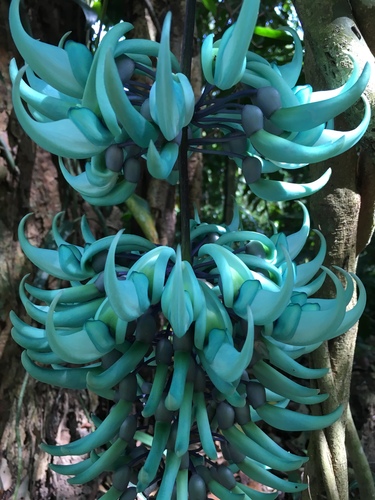
Jade vine at a glance
| Type | Perennial flowering plant, evergreen |
|---|---|
| Family | Fabaceae |
| Mature height | 5–15 m (16–49 ft) |
| Mature spread | 3–6 m (10–20 ft) |
| Spacing | 4 m (13 ft) centre to centre |
| Sun | Part sun to part shade, at least 4 h of direct sun a day |
| Water | High; drought tolerance none, waterlogging tolerance none |
| Soil pH | 5.5–7 |
| Cold hardiness | About 15 °C (59 °F) once established (roughly USDA zone 12) |
| Heat stress | Likely above about 34 °C (93 °F) |
| Flowering | from about March for 4–9 weeks (northern hemisphere; later in cold climates, earlier in warm ones) |
| Wind tolerance | None |
| Pollinator value | Moderate |
| Edible | Not grown as food |
| Native to | Philippines (endemic; rainforest) |
| Common in gardens of | 🇵🇭 Philippines, 🇸🇬 Singapore, 🇬🇧 United Kingdom, 🇺🇸 United States |
Is Jade vine toxic?
- People: not well documented
- Cats: not well documented
- Dogs: not well documented
No reliable toxicity data; treat with caution.
If a child or pet may have eaten part of a plant, call a poison centre or vet straight away.
Companion planting: what to grow with Jade vine
Good neighbours
- good With Sweet corn: "Three sisters": climbing beans use corn as a support and fix nitrogen; the benefit to the corn is modest but real in low-input soils. Evidence C
Keep apart or take care
- caution With Alliums (onion family): Onions, garlic and leeks are said to stunt beans and peas (allium root exudates may reduce nodulation). Traditional companion-planting advice; controlled trials are few, so treat it as a soft preference. Evidence D
- caution With Alliums (onion family): Beans and peas are traditionally kept away from onions, garlic and leeks. Traditional companion-planting advice; controlled trials are few, so treat it as a soft preference. Evidence D
- caution With Fennel: Fennel is reported to suppress beans and peas growing next to it. Evidence C
Questions about Jade vine
- How far apart should I plant Jade vine?
- About 4 m (13 ft) apart, centre to centre. A mature plant spreads 3–6 m (10–20 ft).
- Does Jade vine need full sun?
- Part sun to part shade: at least 4 hours of direct sun a day.
- How much water does Jade vine need?
- High water. Drought tolerance is none and waterlogging tolerance none.
- How cold-hardy is Jade vine?
- It tolerates about 15 °C (59 °F) once established, roughly USDA zone 12.
- When does Jade vine flower?
- From about March for 4–9 weeks (northern hemisphere; later in cold climates, earlier in warm ones).
- Is Jade vine poisonous to cats and dogs?
- For cats it is not well documented; for dogs not well documented; for people not well documented. No reliable toxicity data; treat with caution.
- What grows well with Jade vine?
- "Three sisters": climbing beans use corn as a support and fix nitrogen; the benefit to the corn is modest but real in low-input soils.
Sources and evidence
Evidence grade B (B: extension service or peer-reviewed).
- Kew Gardens: Palm House, Temperate House, Rock Garden and Mediterranean Garden, Royal Botanic Gardens, Kew
- IUCN Red List of Threatened Species, IUCN
Notes and assumptions
- Metre-long hanging trusses of claw-shaped turquoise flowers, pollinated by bats. Grow over a pergola so flowers hang through. Vulnerable in the wild.
Reference values for planning, not horticultural, veterinary or medical advice. Varieties, soils and local climates differ: check with a local nursery or extension service.
Related plants
- Bush bean Phaseolus vulgaris
- Garden pea Pisum sativum
- Sweet pea Lathyrus odoratus
- Runner bean Phaseolus coccineus
- Broad bean (fava) Vicia faba
- Lima bean Phaseolus lunatus
- Cowpea (black-eyed pea) Vigna unguiculata
- Yardlong bean Vigna unguiculata subsp. sesquipedalis