Himalayan blue poppy Meconopsis betonicifolia
Himalayan blue poppy (Meconopsis betonicifolia) is a deciduous perennial flowering plant in the Papaveraceae family, native to SE Tibet, Yunnan and Myanmar (moist alpine meadows and forest edges). It grows 80 cm–1.2 m (31 in–3.9 ft) tall and 40–50 cm (16–20 in) wide, wants part sun to part shade and high water, and is hardy to about -20 °C (-4 °F). Space plants about 45 cm (18 in) apart.
Plan Himalayan blue poppy in your garden →
Free. Draw your beds, then watch it grow through the year in 2D and 3D.
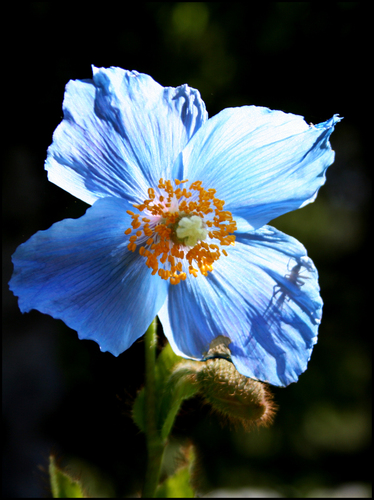
Himalayan blue poppy at a glance
| Type | Perennial flowering plant, deciduous |
|---|---|
| Family | Papaveraceae |
| Mature height | 80 cm–1.2 m (31 in–3.9 ft) |
| Mature spread | 40–50 cm (16–20 in) |
| Spacing | 45 cm (18 in) centre to centre |
| Sun | Part sun to part shade, at least 3 h of direct sun a day |
| Water | High; drought tolerance none, waterlogging tolerance none |
| Soil pH | 5–6.5 |
| Cold hardiness | About -20 °C (-4 °F) once established (roughly USDA zone 6) |
| Heat stress | Likely above about 24 °C (75 °F) |
| Flowering | from about June for 3–5 weeks (northern hemisphere; later in cold climates, earlier in warm ones) |
| Wind tolerance | Low |
| Pollinator value | Moderate |
| Edible | Not grown as food |
| Native to | SE Tibet, Yunnan and Myanmar (moist alpine meadows and forest edges) |
| Common in gardens of | 🇬🇧 United Kingdom, 🇨🇳 China |
Is Himalayan blue poppy toxic?
- People: mildly toxic
- Cats: mildly toxic
- Dogs: mildly toxic
- Parts: all parts
Poppies contain alkaloids; may upset the stomach if eaten.
If a child or pet may have eaten part of a plant, call a poison centre or vet straight away.
Companion planting: what to grow with Himalayan blue poppy
No well-documented helpful pairing. Group it with plants that like part sun to part shade and high water.
See Himalayan blue poppy in a botanical garden
It grows in these sample gardens, which you can walk through in 3D:
- UC Botanical Garden, Berkeley (8 plants)
- Arctic-Alpine Botanic Garden (36 plants)
- Kew: glasshouses and rock garden (8 plants)
Questions about Himalayan blue poppy
- How far apart should I plant Himalayan blue poppy?
- About 45 cm (18 in) apart, centre to centre. A mature plant spreads 40–50 cm (16–20 in).
- Does Himalayan blue poppy need full sun?
- Part sun to part shade: at least 3 hours of direct sun a day.
- How much water does Himalayan blue poppy need?
- High water. Drought tolerance is none and waterlogging tolerance none.
- How cold-hardy is Himalayan blue poppy?
- It tolerates about -20 °C (-4 °F) once established, roughly USDA zone 6.
- When does Himalayan blue poppy flower?
- From about June for 3–5 weeks (northern hemisphere; later in cold climates, earlier in warm ones).
- Is Himalayan blue poppy poisonous to cats and dogs?
- For cats it is mildly toxic; for dogs mildly toxic; for people mildly toxic. Poppies contain alkaloids; may upset the stomach if eaten.
- What grows well with Himalayan blue poppy?
- There is no well-documented companion pairing for Himalayan blue poppy. Group it with plants that like the same sun (part sun to part shade) and water (high).
Sources and evidence
Evidence grade B (B: extension service or peer-reviewed).
- RHS Plant Finder, Royal Horticultural Society
- Plants of the World Online (taxonomy, native range), Royal Botanic Gardens, Kew
Notes and assumptions
- Needs cool summers, humus-rich acid soil and steady moisture; fails in hot, dry gardens. Often short-lived: remove first-year buds to make it perennial.
Reference values for planning, not horticultural, veterinary or medical advice. Varieties, soils and local climates differ: check with a local nursery or extension service.
Related plants
- Field poppy Papaver rhoeas
- Bleeding heart Lamprocapnos spectabilis
- California poppy Eschscholzia californica
- Oriental poppy Papaver orientale
- Matilija poppy Romneya coulteri
- Arctic poppy Papaver radicatum
- Bloodroot Sanguinaria canadensis
- Dutchman’s breeches Dicentra cucullaria