Giant taro (elephant ear) Alocasia macrorrhizos
Giant taro (elephant ear) (Alocasia macrorrhizos) is an evergreen perennial shrub in the Araceae family, native to Borneo, the Philippines and Queensland (wet forest). It grows 2–4 m (6.6–13 ft) tall and 1.5–3 m (4.9–10 ft) wide, wants part sun to part shade and high water, and is hardy to about 7 °C (45 °F). Space plants about 1.8 m (5.9 ft) apart.
Plan Giant taro (elephant ear) in your garden →
Free. Draw your beds, then watch it grow through the year in 2D and 3D.
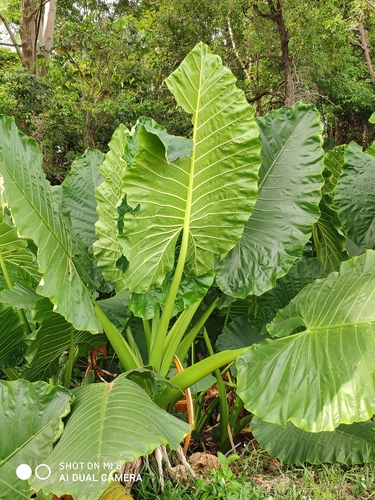
Giant taro (elephant ear) at a glance
| Type | Perennial shrub, evergreen |
|---|---|
| Family | Araceae |
| Mature height | 2–4 m (6.6–13 ft) |
| Mature spread | 1.5–3 m (4.9–10 ft) |
| Spacing | 1.8 m (5.9 ft) centre to centre |
| Sun | Part sun to part shade, at least 3 h of direct sun a day |
| Water | High; drought tolerance none, waterlogging tolerance high |
| Soil pH | 5.5–7.5 |
| Cold hardiness | About 7 °C (45 °F) once established (roughly USDA zone 11) |
| Heat stress | Likely above about 36 °C (97 °F) |
| Flowering | from about June for 3–6 weeks (northern hemisphere; later in cold climates, earlier in warm ones) |
| Wind tolerance | None |
| Pollinator value | None |
| Edible | Yes: stem and corm (only after long cooking) |
| Native to | Borneo, the Philippines and Queensland (wet forest) |
| Common in gardens of | 🇹🇭 Thailand, 🇸🇬 Singapore, 🇦🇺 Australia |
Is Giant taro (elephant ear) toxic?
- People: moderately toxic
- Cats: moderately toxic
- Dogs: moderately toxic
- Parts: all parts raw, sap
Calcium oxalate crystals cause intense mouth and throat pain and swelling; edible only after prolonged cooking.
If a child or pet may have eaten part of a plant, call a poison centre or vet straight away.
Companion planting: what to grow with Giant taro (elephant ear)
No well-documented helpful pairing. Group it with plants that like part sun to part shade and high water.
See Giant taro (elephant ear) in a botanical garden
It grows in these sample gardens, which you can walk through in 3D:
- The Huntington (3 plants)
- Missouri Botanical Garden (3 plants)
- Jardim Botânico do Rio de Janeiro (3 plants)
- Denver Botanic Gardens (3 plants)
- Na ʻĀina Kai Botanical Gardens (4 plants)
- New York Botanical Garden (3 plants)
- Kew: glasshouses and rock garden (5 plants)
Questions about Giant taro (elephant ear)
- How far apart should I plant Giant taro (elephant ear)?
- About 1.8 m (5.9 ft) apart, centre to centre. A mature plant spreads 1.5–3 m (4.9–10 ft).
- Does Giant taro (elephant ear) need full sun?
- Part sun to part shade: at least 3 hours of direct sun a day.
- How much water does Giant taro (elephant ear) need?
- High water. Drought tolerance is none and waterlogging tolerance high.
- How cold-hardy is Giant taro (elephant ear)?
- It tolerates about 7 °C (45 °F) once established, roughly USDA zone 11.
- When does Giant taro (elephant ear) flower?
- From about June for 3–6 weeks (northern hemisphere; later in cold climates, earlier in warm ones).
- Is Giant taro (elephant ear) poisonous to cats and dogs?
- For cats it is moderately toxic; for dogs moderately toxic; for people moderately toxic. Calcium oxalate crystals cause intense mouth and throat pain and swelling; edible only after prolonged cooking.
- What grows well with Giant taro (elephant ear)?
- There is no well-documented companion pairing for Giant taro (elephant ear). Group it with plants that like the same sun (part sun to part shade) and water (high).
Sources and evidence
Evidence grade B (B: extension service or peer-reviewed).
- Plants of the World Online (taxonomy, native range), Royal Botanic Gardens, Kew
- ASPCA Toxic and Non-Toxic Plant List, ASPCA
- UF/IFAS Extension tropical and subtropical fruit and landscape publications, University of Florida
Notes and assumptions
- Tropical: outdoors only in frost-free climates; in temperate gardens grow it under heated glass (as in the Kew Palm House).
- Typical garden-form values; cultivars and local conditions differ.
Reference values for planning, not horticultural, veterinary or medical advice. Varieties, soils and local climates differ: check with a local nursery or extension service.
Related plants
- Taro Colocasia esculenta
- Calla lily (arum lily) Zantedeschia aethiopica
- Caladium (angel wings) Caladium bicolor
- Lacy tree philodendron Thaumatophyllum bipinnatifidum
- Swiss cheese plant Monstera deliciosa
- Flamingo flower Anthurium andraeanum
- Tannia (malanga, yautía, cocoyam) Xanthosoma sagittifolium
- Elephant foot yam (suran, buk) Amorphophallus paeoniifolius