Climbing hydrangea Hydrangea anomala subsp. petiolaris
Climbing hydrangea (Hydrangea anomala subsp. petiolaris) is a deciduous perennial shrub in the Hydrangeaceae family, native to Japan, Korea and Sakhalin. It grows 8–15 m (26–49 ft) tall and 3–6 m (10–20 ft) wide, wants shade and moderate water, and is hardy to about -35 °C (-31 °F). Space plants about 3 m (10 ft) apart.
Plan Climbing hydrangea in your garden →
Free. Draw your beds, then watch it grow through the year in 2D and 3D.
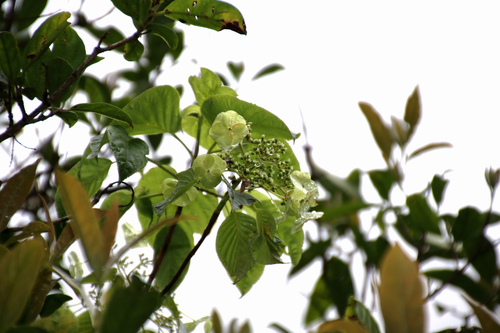
Climbing hydrangea at a glance
| Type | Perennial shrub, deciduous |
|---|---|
| Family | Hydrangeaceae |
| Mature height | 8–15 m (26–49 ft) |
| Mature spread | 3–6 m (10–20 ft) |
| Spacing | 3 m (10 ft) centre to centre |
| Sun | Shade, at least 2 h of direct sun a day |
| Water | Moderate; drought tolerance low, waterlogging tolerance none |
| Soil pH | 5–7.5 |
| Cold hardiness | About -35 °C (-31 °F) once established (roughly USDA zone 3) |
| Heat stress | Likely above about 30 °C (86 °F) |
| Flowering | from about June for 4–6 weeks (northern hemisphere; later in cold climates, earlier in warm ones) |
| Wind tolerance | Moderate |
| Pollinator value | High |
| Edible | Not grown as food |
| Native to | Japan, Korea and Sakhalin |
| Common in gardens of | 🇯🇵 Japan, 🇰🇷 South Korea, 🇷🇺 Russia, 🇺🇸 United States, 🇬🇧 United Kingdom, 🇩🇪 Germany, 🇨🇦 Canada |
Is Climbing hydrangea toxic?
- People: mildly toxic
- Cats: mildly toxic
- Dogs: mildly toxic
- Parts: leaves, flowers
Contains cyanogenic glycosides like other hydrangeas.
If a child or pet may have eaten part of a plant, call a poison centre or vet straight away.
Companion planting: what to grow with Climbing hydrangea
No well-documented helpful pairing. Group it with plants that like shade and moderate water.
Questions about Climbing hydrangea
- How far apart should I plant Climbing hydrangea?
- About 3 m (10 ft) apart, centre to centre. A mature plant spreads 3–6 m (10–20 ft).
- Does Climbing hydrangea need full sun?
- Shade: at least 2 hours of direct sun a day.
- How much water does Climbing hydrangea need?
- Moderate water. Drought tolerance is low and waterlogging tolerance none.
- How cold-hardy is Climbing hydrangea?
- It tolerates about -35 °C (-31 °F) once established, roughly USDA zone 3.
- When does Climbing hydrangea flower?
- From about June for 4–6 weeks (northern hemisphere; later in cold climates, earlier in warm ones).
- Is Climbing hydrangea poisonous to cats and dogs?
- For cats it is mildly toxic; for dogs mildly toxic; for people mildly toxic. Contains cyanogenic glycosides like other hydrangeas.
- What grows well with Climbing hydrangea?
- There is no well-documented companion pairing for Climbing hydrangea. Group it with plants that like the same sun (shade) and water (moderate).
Sources and evidence
Evidence grade A (A: strong evidence).
- RHS Plant Finder, Royal Horticultural Society
- Missouri Botanical Garden Plant Finder, Missouri Botanical Garden
Notes and assumptions
- Clings by aerial roots to shady north walls and big trunks; lacecap flowers in early summer, peeling cinnamon bark in winter. Slow for the first few years.
Reference values for planning, not horticultural, veterinary or medical advice. Varieties, soils and local climates differ: check with a local nursery or extension service.
Related plants
- Bigleaf hydrangea Hydrangea macrophylla
- Mock orange Philadelphus coronarius
- Panicle hydrangea Hydrangea paniculata
- Smooth hydrangea 'Annabelle' Hydrangea arborescens
- Slender deutzia (himeutsugi) Deutzia gracilis
- Mountain hydrangea (yama-ajisai) Hydrangea serrata
- Yellow wax bells (kirenga-shōma) Kirengeshoma palmata
- Rough-leaved hydrangea Hydrangea aspera