Black mustard Brassica nigra
Black mustard (Brassica nigra) is an annual herb in the Brassicaceae family, native to Mediterranean to western Asia. It grows 1–2.4 m (3.3–7.9 ft) tall and 40–90 cm (16–35 in) wide, wants full sun and low water, and is hardy to about -5 °C (23 °F). Space plants about 30 cm (12 in) apart.
Plan Black mustard in your garden →
Free. Draw your beds, then watch it grow through the year in 2D and 3D.
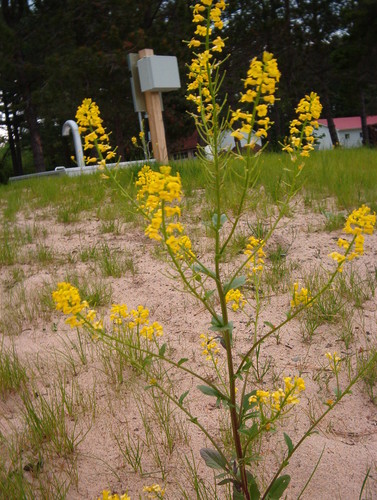
Black mustard at a glance
| Type | Annual herb |
|---|---|
| Family | Brassicaceae |
| Mature height | 1–2.4 m (3.3–7.9 ft) |
| Mature spread | 40–90 cm (16–35 in) |
| Spacing | 30 cm (12 in) centre to centre |
| Sun | Full sun, at least 6 h of direct sun a day |
| Water | Low; drought tolerance moderate, waterlogging tolerance none |
| Soil pH | 6–7.5 |
| Cold hardiness | About -5 °C (23 °F) once established (roughly USDA zone 9) |
| Heat stress | Likely above about 32 °C (90 °F) |
| Flowering | about 6–9 weeks after planting, for 4–7 weeks |
| Days to maturity | About 100 days from planting |
| Wind tolerance | Low |
| Pollinator value | Moderate |
| Edible | Yes: seeds (pungent mustard), young leaves |
| Native to | Mediterranean to western Asia |
| Common in gardens of | 🇮🇳 India, 🇪🇹 Ethiopia, 🇹🇷 Turkey, 🇮🇷 Iran, 🇪🇬 Egypt, 🇮🇹 Italy, 🇫🇷 France, 🇺🇸 United States |
| Invasive in | California (Cal-IPC), parts of Australia: check local rules before planting |
Is Black mustard toxic?
- People: mildly toxic
- Cats: mildly toxic
- Dogs: mildly toxic
- Parts: seeds, leaves in quantity
Mustard oils irritate the gut and skin in large amounts; livestock have been poisoned by large amounts of seed.
If a child or pet may have eaten part of a plant, call a poison centre or vet straight away.
Companion planting: what to grow with Black mustard
Good neighbours
- good With Rhubarb: Traditional lore says rhubarb planted near brassicas helps against clubroot and pests; the evidence is weak and not confirmed by trials. Evidence D
- good With Nasturtium: Nasturtiums act as a trap crop for cabbage white butterflies and blackfly, drawing some pressure away from brassicas. Evidence C
Questions about Black mustard
- How far apart should I plant Black mustard?
- About 30 cm (12 in) apart, centre to centre. A mature plant spreads 40–90 cm (16–35 in).
- Does Black mustard need full sun?
- Full sun: at least 6 hours of direct sun a day.
- How much water does Black mustard need?
- Low water. Drought tolerance is moderate and waterlogging tolerance none.
- How cold-hardy is Black mustard?
- It tolerates about -5 °C (23 °F) once established, roughly USDA zone 9. As an annual it is usually planted out after the last frost.
- When does Black mustard flower?
- About 6–9 weeks after planting, for 4–7 weeks.
- Is Black mustard poisonous to cats and dogs?
- For cats it is mildly toxic; for dogs mildly toxic; for people mildly toxic. Mustard oils irritate the gut and skin in large amounts; livestock have been poisoned by large amounts of seed.
- What grows well with Black mustard?
- Traditional lore says rhubarb planted near brassicas helps against clubroot and pests; the evidence is weak and not confirmed by trials. Nasturtiums act as a trap crop for cabbage white butterflies and blackfly, drawing some pressure away from brassicas.
Sources and evidence
Evidence grade B (B: extension service or peer-reviewed).
- Plants of the World Online (taxonomy, native range), Royal Botanic Gardens, Kew
- GRIN-Global Taxonomy, USDA ARS
- CABI Invasive Species Compendium, CABI
Notes and assumptions
- Some recent treatments move it out of Brassica (as Rhamphospermum or Mutarda nigra); GBIF still accepts Brassica nigra. The classic mustard seed of the parable and of Dijon until the 1950s, when harvest-friendlier brown mustard (B. juncea) replaced it. Tall, branching and shatters its pods, so it is hard to harvest by machine.
Reference values for planning, not horticultural, veterinary or medical advice. Varieties, soils and local climates differ: check with a local nursery or extension service.
Related plants
- Broccoli Brassica oleracea var. italica
- Cauliflower Brassica oleracea var. botrytis
- Cabbage Brassica oleracea var. capitata
- Kale Brassica oleracea var. sabellica
- Radish Raphanus sativus
- Bok choy Brassica rapa subsp. chinensis
- Brussels sprout Brassica oleracea var. gemmifera
- Kohlrabi Brassica oleracea var. gongylodes