Black-eyed Susan Rudbeckia hirta
Black-eyed Susan (Rudbeckia hirta) is a biennial flowering plant in the Asteraceae family. It grows 50–90 cm (20–35 in) tall and 30–50 cm (12–20 in) wide, wants full sun and low water, and is hardy to about -30 °C (-22 °F). Space plants about 40 cm (16 in) apart.
Plan Black-eyed Susan in your garden →
Free. Draw your beds, then watch it grow through the year in 2D and 3D.
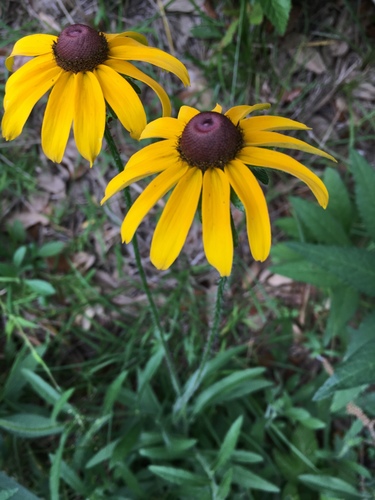
Black-eyed Susan at a glance
| Type | Biennial flowering plant |
|---|---|
| Family | Asteraceae |
| Mature height | 50–90 cm (20–35 in) |
| Mature spread | 30–50 cm (12–20 in) |
| Spacing | 40 cm (16 in) centre to centre |
| Sun | Full sun, at least 6 h of direct sun a day |
| Water | Low; drought tolerance moderate, waterlogging tolerance low |
| Cold hardiness | About -30 °C (-22 °F) once established (roughly USDA zone 4) |
| Heat stress | Likely above about 36 °C (97 °F) |
| Flowering | about 13–21 weeks after planting, for 9–14 weeks |
| Days to maturity | About 120 days from planting |
| Wind tolerance | Low |
| Pollinator value | High |
| Edible | Not grown as food |
| Common in gardens of | 🇺🇸 United States, 🇬🇧 United Kingdom, 🇩🇪 Germany, 🇨🇦 Canada |
Is Black-eyed Susan toxic?
- People: not known to be toxic
- Cats: not well documented
- Dogs: not well documented
Rudbeckia toxicity is not well documented; some references list mild effects.
If a child or pet may have eaten part of a plant, call a poison centre or vet straight away.
Companion planting: what to grow with Black-eyed Susan
No well-documented helpful pairing. Group it with plants that like full sun and low water.
See Black-eyed Susan in a botanical garden
It grows in these sample gardens, which you can walk through in 3D:
- Missouri Botanical Garden (12 plants)
- Longwood Gardens (16 plants)
- Denver Botanic Gardens (14 plants)
- New York Botanical Garden (12 plants)
- Riverside botanical garden (20 plants)
Questions about Black-eyed Susan
- How far apart should I plant Black-eyed Susan?
- About 40 cm (16 in) apart, centre to centre. A mature plant spreads 30–50 cm (12–20 in).
- Does Black-eyed Susan need full sun?
- Full sun: at least 6 hours of direct sun a day.
- How much water does Black-eyed Susan need?
- Low water. Drought tolerance is moderate and waterlogging tolerance low.
- How cold-hardy is Black-eyed Susan?
- It tolerates about -30 °C (-22 °F) once established, roughly USDA zone 4. As a biennial it is usually planted out after the last frost and flowers in its second year.
- When does Black-eyed Susan flower?
- About 13–21 weeks after planting, for 9–14 weeks.
- Is Black-eyed Susan poisonous to cats and dogs?
- For cats it is not well documented; for dogs not well documented; for people not known to be toxic. Rudbeckia toxicity is not well documented; some references list mild effects.
- What grows well with Black-eyed Susan?
- There is no well-documented companion pairing for Black-eyed Susan. Group it with plants that like the same sun (full sun) and water (low).
Sources and evidence
Evidence grade C (C: plausible, mixed evidence).
- ASPCA Toxic and Non-Toxic Plant List, ASPCA
- FAO Irrigation and Drainage Paper 56 — Crop Evapotranspiration, FAO
- RHS Plant Finder, Royal Horticultural Society
- University extension gardening guides (general), Various land-grant university extensions
Notes and assumptions
- Typical garden-cultivar values; varieties differ.
- Short-lived; often self-seeds and acts as a perennial.
Reference values for planning, not horticultural, veterinary or medical advice. Varieties, soils and local climates differ: check with a local nursery or extension service.
Related plants
- Lettuce Lactuca sativa
- Sunflower Helianthus annuus
- French marigold Tagetes patula
- Zinnia Zinnia elegans
- Cosmos Cosmos bipinnatus
- Purple coneflower Echinacea purpurea
- French tarragon Artemisia dracunculus
- German chamomile Matricaria chamomilla