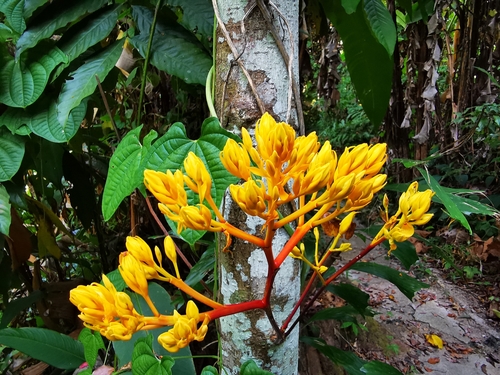
Yellow saraca Saraca cauliflora
Yellow saraca (Saraca cauliflora) is an evergreen perennial tree in the Fabaceae family, native to Thailand, Peninsular Malaysia, Sumatra and Java (river banks in forest). It grows 6–12 m (20–39 ft) tall and 6–10 m (20–33 ft) wide, wants part sun to part shade and high water, and is hardy to about 10 °C (50 °F). Space plants about 7 m (23 ft) apart.
Plan Yellow saraca in your garden →
Free. Draw your beds, then watch it grow through the year in 2D and 3D.
Yellow saraca at a glance
| Type | Perennial tree, evergreen |
|---|---|
| Family | Fabaceae |
| Mature height | 6–12 m (20–39 ft) |
| Mature spread | 6–10 m (20–33 ft) |
| Spacing | 7 m (23 ft) centre to centre |
| Sun | Part sun to part shade, at least 4 h of direct sun a day |
| Water | High; drought tolerance none, waterlogging tolerance moderate |
| Soil pH | 5–7 |
| Cold hardiness | About 10 °C (50 °F) once established (roughly USDA zone 12) |
| Heat stress | Likely above about 36 °C (97 °F) |
| Flowering | from about February for 4–9 weeks (northern hemisphere; later in cold climates, earlier in warm ones) |
| Wind tolerance | Low |
| Pollinator value | High |
| Edible | Not grown as food |
| Native to | Thailand, Peninsular Malaysia, Sumatra and Java (river banks in forest) |
| Common in gardens of | 🇸🇬 Singapore, 🇹🇭 Thailand |
Is Yellow saraca toxic?
- People: not known to be toxic
- Cats: not known to be toxic
- Dogs: not known to be toxic
No toxicity reported in ASPCA or standard poison references.
If a child or pet may have eaten part of a plant, call a poison centre or vet straight away.
Companion planting: what to grow with Yellow saraca
Good neighbours
- good With Sweet corn: "Three sisters": climbing beans use corn as a support and fix nitrogen; the benefit to the corn is modest but real in low-input soils. Evidence C
Keep apart or take care
- caution With Alliums (onion family): Onions, garlic and leeks are said to stunt beans and peas (allium root exudates may reduce nodulation). Traditional companion-planting advice; controlled trials are few, so treat it as a soft preference. Evidence D
- caution With Alliums (onion family): Beans and peas are traditionally kept away from onions, garlic and leeks. Traditional companion-planting advice; controlled trials are few, so treat it as a soft preference. Evidence D
- caution With Fennel: Fennel is reported to suppress beans and peas growing next to it. Evidence C
See Yellow saraca in a botanical garden
It grows in this sample garden, which you can walk through in 3D:
- Singapore Botanic Gardens (1 plants)
Questions about Yellow saraca
- How far apart should I plant Yellow saraca?
- About 7 m (23 ft) apart, centre to centre. A mature plant spreads 6–10 m (20–33 ft).
- Does Yellow saraca need full sun?
- Part sun to part shade: at least 4 hours of direct sun a day.
- How much water does Yellow saraca need?
- High water. Drought tolerance is none and waterlogging tolerance moderate.
- How cold-hardy is Yellow saraca?
- It tolerates about 10 °C (50 °F) once established, roughly USDA zone 12.
- When does Yellow saraca flower?
- From about February for 4–9 weeks (northern hemisphere; later in cold climates, earlier in warm ones).
- Is Yellow saraca poisonous to cats and dogs?
- For cats it is not known to be toxic; for dogs not known to be toxic; for people not known to be toxic. No toxicity reported in ASPCA or standard poison references.
- What grows well with Yellow saraca?
- "Three sisters": climbing beans use corn as a support and fix nitrogen; the benefit to the corn is modest but real in low-input soils.
Sources and evidence
Evidence grade B (B: extension service or peer-reviewed).
- Flora & Fauna Web, National Parks Board, Singapore
- Plants of the World Online (taxonomy, native range), Royal Botanic Gardens, Kew
- Singapore Botanic Gardens: Rainforest, National Orchid Garden, Ginger Garden, Learning Forest, National Parks Board, Singapore
Notes and assumptions
- Tropical lowland plant: outdoors only where it never frosts (as in Singapore); elsewhere it needs a heated glasshouse.
- Dense clusters of yellow-orange flowers burst from the trunk and branches; new leaves hang in limp pink-brown tassels before they stiffen.
- Typical garden-form values; cultivars and local conditions differ.
Reference values for planning, not horticultural, veterinary or medical advice. Varieties, soils and local climates differ: check with a local nursery or extension service.
Related plants
- Bush bean Phaseolus vulgaris
- Garden pea Pisum sativum
- Sweet pea Lathyrus odoratus
- Runner bean Phaseolus coccineus
- Broad bean (fava) Vicia faba
- Lima bean Phaseolus lunatus
- Cowpea (black-eyed pea) Vigna unguiculata
- Yardlong bean Vigna unguiculata subsp. sesquipedalis