Urn plant (silver vase bromeliad) Aechmea fasciata
Urn plant (silver vase bromeliad) (Aechmea fasciata) is an evergreen perennial flowering plant in the Bromeliaceae family, native to Atlantic forest of Rio de Janeiro state, Brazil (epiphyte). It grows 40–60 cm (16–24 in) tall and 50–70 cm (20–28 in) wide, wants part sun to part shade and low water, and is hardy to about 10 °C (50 °F). Space plants about 50 cm (20 in) apart.
Plan Urn plant (silver vase bromeliad) in your garden →
Free. Draw your beds, then watch it grow through the year in 2D and 3D.
Urn plant (silver vase bromeliad) at a glance
| Type | Perennial flowering plant, evergreen |
|---|---|
| Family | Bromeliaceae |
| Mature height | 40–60 cm (16–24 in) |
| Mature spread | 50–70 cm (20–28 in) |
| Spacing | 50 cm (20 in) centre to centre |
| Sun | Part sun to part shade, at least 3 h of direct sun a day |
| Water | Low; drought tolerance moderate, waterlogging tolerance none |
| Soil pH | 5–6.5 |
| Cold hardiness | About 10 °C (50 °F) once established (roughly USDA zone 12) |
| Heat stress | Likely above about 35 °C (95 °F) |
| Flowering | from about May for 9–21 weeks (northern hemisphere; later in cold climates, earlier in warm ones) |
| Wind tolerance | Low |
| Pollinator value | Low |
| Edible | Not grown as food |
| Native to | Atlantic forest of Rio de Janeiro state, Brazil (epiphyte) |
| Common in gardens of | 🇧🇷 Brazil, 🇸🇬 Singapore |
Is Urn plant (silver vase bromeliad) toxic?
- People: not known to be toxic
- Cats: not known to be toxic
- Dogs: not known to be toxic
Listed as non-toxic to cats and dogs (ASPCA); leaf margins are spiny.
If a child or pet may have eaten part of a plant, call a poison centre or vet straight away.
Companion planting: what to grow with Urn plant (silver vase bromeliad)
No well-documented helpful pairing. Group it with plants that like part sun to part shade and low water.
See Urn plant (silver vase bromeliad) in a botanical garden
It grows in these sample gardens, which you can walk through in 3D:
- Singapore Botanic Gardens (8 plants)
- Gardens by the Bay (10 plants)
- Missouri Botanical Garden (6 plants)
- Jardim Botânico do Rio de Janeiro (10 plants)
- Denver Botanic Gardens (6 plants)
- New York Botanical Garden (4 plants)
- Jardin botanique de Montréal (3 plants)
Questions about Urn plant (silver vase bromeliad)
- How far apart should I plant Urn plant (silver vase bromeliad)?
- About 50 cm (20 in) apart, centre to centre. A mature plant spreads 50–70 cm (20–28 in).
- Does Urn plant (silver vase bromeliad) need full sun?
- Part sun to part shade: at least 3 hours of direct sun a day.
- How much water does Urn plant (silver vase bromeliad) need?
- Low water. Drought tolerance is moderate and waterlogging tolerance none.
- How cold-hardy is Urn plant (silver vase bromeliad)?
- It tolerates about 10 °C (50 °F) once established, roughly USDA zone 12.
- When does Urn plant (silver vase bromeliad) flower?
- From about May for 9–21 weeks (northern hemisphere; later in cold climates, earlier in warm ones).
- Is Urn plant (silver vase bromeliad) poisonous to cats and dogs?
- For cats it is not known to be toxic; for dogs not known to be toxic; for people not known to be toxic. Listed as non-toxic to cats and dogs (ASPCA); leaf margins are spiny.
- What grows well with Urn plant (silver vase bromeliad)?
- There is no well-documented companion pairing for Urn plant (silver vase bromeliad). Group it with plants that like the same sun (part sun to part shade) and water (low).
Sources and evidence
Evidence grade B (B: extension service or peer-reviewed).
- Plants of the World Online (taxonomy, native range), Royal Botanic Gardens, Kew
- ASPCA Toxic and Non-Toxic Plant List, ASPCA
- Singapore Botanic Gardens: Rainforest, National Orchid Garden, Ginger Garden, Learning Forest, National Parks Board, Singapore
Notes and assumptions
- Tropical lowland plant: outdoors only where it never frosts (as in Singapore); elsewhere it needs a heated glasshouse.
- Epiphyte: grows on branches in nature; in a garden it is tied onto trees, tree-fern trunks or rock, or grown in very open bark mix.
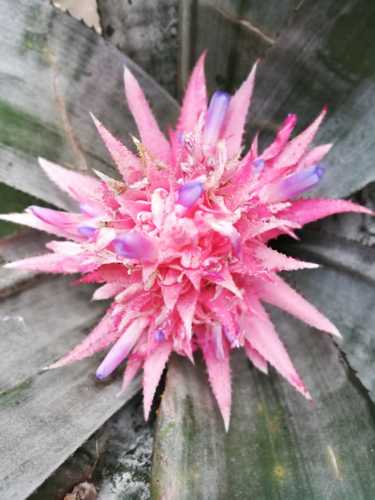
- Silver-banded leaves form a water-holding urn; a pink bracted head with small blue flowers lasts for months, then the rosette dies and pups replace it.
Reference values for planning, not horticultural, veterinary or medical advice. Varieties, soils and local climates differ: check with a local nursery or extension service.
Related plants
- Pineapple Ananas comosus
- Scarlet star bromeliad Guzmania lingulata
- Imperial bromeliad Alcantarea imperialis
- Chilean puya Puya chilensis
- Spanish moss Tillandsia usneoides
- Air plant (blushing tillandsia) Tillandsia ionantha
- Blushing bromeliad Neoregelia carolinae
- Flaming sword (vriesea) Lutheria splendens