Texas sage (cenizo) Leucophyllum frutescens
Texas sage (cenizo) (Leucophyllum frutescens) is an evergreen perennial shrub in the Scrophulariaceae family, native to Chihuahuan Desert of Texas and northern Mexico. It grows 1.2–2.5 m (3.9–8.2 ft) tall and 1.2–2 m (3.9–6.6 ft) wide, wants full sun and low water, and is hardy to about -12 °C (10 °F). Space plants about 1.5 m (4.9 ft) apart.
Plan Texas sage (cenizo) in your garden →
Free. Draw your beds, then watch it grow through the year in 2D and 3D.
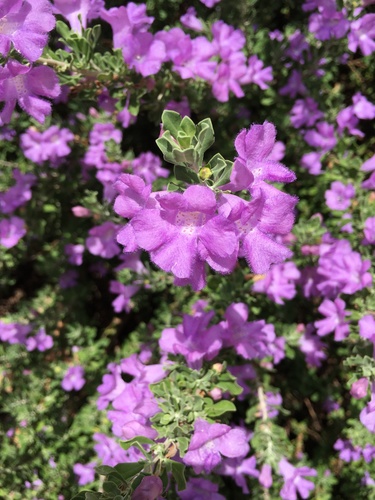
Texas sage (cenizo) at a glance
| Type | Perennial shrub, evergreen |
|---|---|
| Family | Scrophulariaceae |
| Mature height | 1.2–2.5 m (3.9–8.2 ft) |
| Mature spread | 1.2–2 m (3.9–6.6 ft) |
| Spacing | 1.5 m (4.9 ft) centre to centre |
| Sun | Full sun, at least 7 h of direct sun a day |
| Water | Low; drought tolerance high, waterlogging tolerance none |
| Soil pH | 6.5–8.5 |
| Cold hardiness | About -12 °C (10 °F) once established (roughly USDA zone 8) |
| Heat stress | Likely above about 46 °C (115 °F) |
| Flowering | from about June for 9–21 weeks (northern hemisphere; later in cold climates, earlier in warm ones) |
| Wind tolerance | Moderate |
| Pollinator value | High |
| Edible | Not grown as food |
| Native to | Chihuahuan Desert of Texas and northern Mexico |
| Common in gardens of | 🇺🇸 United States, 🇲🇽 Mexico |
Is Texas sage (cenizo) toxic?
- People: not known to be toxic
- Cats: not known to be toxic
- Dogs: not known to be toxic
No toxicity reported in ASPCA or standard poison references.
If a child or pet may have eaten part of a plant, call a poison centre or vet straight away.
Companion planting: what to grow with Texas sage (cenizo)
No well-documented helpful pairing. Group it with plants that like full sun and low water.
Questions about Texas sage (cenizo)
- How far apart should I plant Texas sage (cenizo)?
- About 1.5 m (4.9 ft) apart, centre to centre. A mature plant spreads 1.2–2 m (3.9–6.6 ft).
- Does Texas sage (cenizo) need full sun?
- Full sun: at least 7 hours of direct sun a day.
- How much water does Texas sage (cenizo) need?
- Low water. Drought tolerance is high and waterlogging tolerance none.
- How cold-hardy is Texas sage (cenizo)?
- It tolerates about -12 °C (10 °F) once established, roughly USDA zone 8.
- When does Texas sage (cenizo) flower?
- From about June for 9–21 weeks (northern hemisphere; later in cold climates, earlier in warm ones).
- Is Texas sage (cenizo) poisonous to cats and dogs?
- For cats it is not known to be toxic; for dogs not known to be toxic; for people not known to be toxic. No toxicity reported in ASPCA or standard poison references.
- What grows well with Texas sage (cenizo)?
- There is no well-documented companion pairing for Texas sage (cenizo). Group it with plants that like the same sun (full sun) and water (low).
Sources and evidence
Evidence grade A (A: strong evidence).
- Native Plant Information Network, Lady Bird Johnson Wildflower Center, University of Texas at Austin
- UC IPM degree-day models and pest notes, University of California
Notes and assumptions
- Silver-felted shrub that bursts into purple flower after summer rain or humidity (the “barometer bush”). Dies in wet, heavy soil.
Reference values for planning, not horticultural, veterinary or medical advice. Varieties, soils and local climates differ: check with a local nursery or extension service.
Related plants
- Butterfly bush Buddleja davidii
- Bacopa (sutera) Chaenostoma cordatum
- Fountain butterfly bush (alternate-leaved buddleja) Buddleja alternifolia
- Spotted emu bush Eremophila maculata
- Creeping boobialla Myoporum parvifolium
- Olympian mullein Verbascum olympicum
- Bigleaf hydrangea Hydrangea macrophylla
- Rhododendron Rhododendron