Putat sungai (freshwater mangrove) Barringtonia racemosa
Putat sungai (freshwater mangrove) (Barringtonia racemosa) is an evergreen perennial tree in the Lecythidaceae family, native to East Africa to the Pacific islands, including Singapore (back mangroves, river banks and freshwater swamp forest). It grows 4–15 m (13–49 ft) tall and 4–8 m (13–26 ft) wide, wants part sun to part shade and high water, and is hardy to about 7 °C (45 °F). Space plants about 5 m (16 ft) apart.
Plan Putat sungai (freshwater mangrove) in your garden →
Free. Draw your beds, then watch it grow through the year in 2D and 3D.
Putat sungai (freshwater mangrove) at a glance
| Type | Perennial tree, evergreen |
|---|---|
| Family | Lecythidaceae |
| Mature height | 4–15 m (13–49 ft) |
| Mature spread | 4–8 m (13–26 ft) |
| Spacing | 5 m (16 ft) centre to centre |
| Sun | Part sun to part shade, at least 4 h of direct sun a day |
| Water | High; drought tolerance none, waterlogging tolerance high |
| Soil pH | 5–7.5 |
| Cold hardiness | About 7 °C (45 °F) once established (roughly USDA zone 11) |
| Heat stress | Likely above about 38 °C (100 °F) |
| Flowering | from about March for 21–43 weeks (northern hemisphere; later in cold climates, earlier in warm ones) |
| Wind tolerance | Low |
| Pollinator value | High |
| Edible | Not grown as food |
| Native to | East Africa to the Pacific islands, including Singapore (back mangroves, river banks and freshwater swamp forest) |
| Common in gardens of | 🇸🇬 Singapore, 🇹🇭 Thailand, 🇦🇺 Australia, 🇿🇦 South Africa |
Is Putat sungai (freshwater mangrove) toxic?
- People: mildly toxic
- Cats: not well documented
- Dogs: not well documented
- Parts: seeds, fruit, bark
Saponins in the seeds, fruit and bark were used to stun fish; not for eating.
If a child or pet may have eaten part of a plant, call a poison centre or vet straight away.
Companion planting: what to grow with Putat sungai (freshwater mangrove)
No well-documented helpful pairing. Group it with plants that like part sun to part shade and high water.
Questions about Putat sungai (freshwater mangrove)
- How far apart should I plant Putat sungai (freshwater mangrove)?
- About 5 m (16 ft) apart, centre to centre. A mature plant spreads 4–8 m (13–26 ft).
- Does Putat sungai (freshwater mangrove) need full sun?
- Part sun to part shade: at least 4 hours of direct sun a day.
- How much water does Putat sungai (freshwater mangrove) need?
- High water. Drought tolerance is none and waterlogging tolerance high.
- How cold-hardy is Putat sungai (freshwater mangrove)?
- It tolerates about 7 °C (45 °F) once established, roughly USDA zone 11.
- When does Putat sungai (freshwater mangrove) flower?
- From about March for 21–43 weeks (northern hemisphere; later in cold climates, earlier in warm ones).
- Is Putat sungai (freshwater mangrove) poisonous to cats and dogs?
- For cats it is not well documented; for dogs not well documented; for people mildly toxic. Saponins in the seeds, fruit and bark were used to stun fish; not for eating.
- What grows well with Putat sungai (freshwater mangrove)?
- There is no well-documented companion pairing for Putat sungai (freshwater mangrove). Group it with plants that like the same sun (part sun to part shade) and water (high).
Sources and evidence
Evidence grade B (B: extension service or peer-reviewed).
- Flora & Fauna Web, National Parks Board, Singapore
- Mangrove plants of Singapore (fact sheets; after Ng & Sivasothi, A Guide to the Mangroves of Singapore), WildSingapore
- Plants of the World Online (taxonomy, native range), Royal Botanic Gardens, Kew
Notes and assumptions
- Freshwater or peat swamp plant: needs permanently wet, acidic, waterlogged ground.
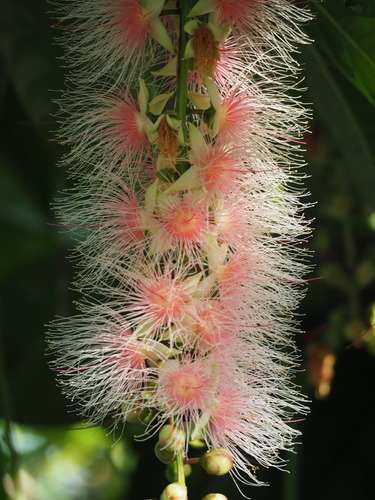
- Pendant strings up to 1 m long of pink-white, powder-puff flowers that open at night and fall by morning; four-angled floating fruits.
- Typical garden-form values; cultivars and local conditions differ.
Reference values for planning, not horticultural, veterinary or medical advice. Varieties, soils and local climates differ: check with a local nursery or extension service.
Related plants
- Cannonball tree Couroupita guianensis
- Dwarf mountain pine Pinus mugo
- Japanese maple Acer palmatum
- Black walnut Juglans nigra
- English yew Taxus baccata
- Serviceberry Amelanchier canadensis
- Japanese flowering cherry Prunus serrulata
- Saucer magnolia Magnolia x soulangeana