Mangrove apple (perepat) Sonneratia alba
Mangrove apple (perepat) (Sonneratia alba) is an evergreen perennial tree in the Lythraceae family, native to Indo-West Pacific, from East Africa to the Pacific islands, including Singapore (sandy and rocky seaward shores). It grows 5–15 m (16–49 ft) tall and 5–9 m (16–30 ft) wide, wants full sun and high water, and is hardy to about 12 °C (54 °F). Space plants about 5 m (16 ft) apart.
Plan Mangrove apple (perepat) in your garden →
Free. Draw your beds, then watch it grow through the year in 2D and 3D.
Mangrove apple (perepat) at a glance
| Type | Perennial tree, evergreen |
|---|---|
| Family | Lythraceae |
| Mature height | 5–15 m (16–49 ft) |
| Mature spread | 5–9 m (16–30 ft) |
| Spacing | 5 m (16 ft) centre to centre |
| Sun | Full sun, at least 6 h of direct sun a day |
| Water | High; drought tolerance low, waterlogging tolerance high |
| Soil pH | 6–8.5 |
| Cold hardiness | About 12 °C (54 °F) once established (roughly USDA zone 12) |
| Heat stress | Likely above about 40 °C (104 °F) |
| Flowering | from about March for 13–29 weeks (northern hemisphere; later in cold climates, earlier in warm ones) |
| Wind tolerance | High |
| Pollinator value | High |
| Edible | Yes: fruit (sour; raw or cooked) |
| Native to | Indo-West Pacific, from East Africa to the Pacific islands, including Singapore (sandy and rocky seaward shores) |
| Common in gardens of | 🇸🇬 Singapore, 🇹🇭 Thailand, 🇦🇺 Australia, 🇿🇦 South Africa |
Is Mangrove apple (perepat) toxic?
- People: not known to be toxic
- Cats: not known to be toxic
- Dogs: not known to be toxic
No toxicity reported in ASPCA or standard poison references.
If a child or pet may have eaten part of a plant, call a poison centre or vet straight away.
Companion planting: what to grow with Mangrove apple (perepat)
No well-documented helpful pairing. Group it with plants that like full sun and high water.
See Mangrove apple (perepat) in a botanical garden
It grows in this sample garden, which you can walk through in 3D:
- Gardens by the Bay (2 plants)
Questions about Mangrove apple (perepat)
- How far apart should I plant Mangrove apple (perepat)?
- About 5 m (16 ft) apart, centre to centre. A mature plant spreads 5–9 m (16–30 ft).
- Does Mangrove apple (perepat) need full sun?
- Full sun: at least 6 hours of direct sun a day.
- How much water does Mangrove apple (perepat) need?
- High water. Drought tolerance is low and waterlogging tolerance high.
- How cold-hardy is Mangrove apple (perepat)?
- It tolerates about 12 °C (54 °F) once established, roughly USDA zone 12.
- When does Mangrove apple (perepat) flower?
- From about March for 13–29 weeks (northern hemisphere; later in cold climates, earlier in warm ones).
- Is Mangrove apple (perepat) poisonous to cats and dogs?
- For cats it is not known to be toxic; for dogs not known to be toxic; for people not known to be toxic. No toxicity reported in ASPCA or standard poison references.
- What grows well with Mangrove apple (perepat)?
- There is no well-documented companion pairing for Mangrove apple (perepat). Group it with plants that like the same sun (full sun) and water (high).
Sources and evidence
Evidence grade B (B: extension service or peer-reviewed).
- Flora & Fauna Web, National Parks Board, Singapore
- Mangrove plants of Singapore (fact sheets; after Ng & Sivasothi, A Guide to the Mangroves of Singapore), WildSingapore
- Plants of the World Online (taxonomy, native range), Royal Botanic Gardens, Kew
Notes and assumptions
- Mangrove: grows in tidal, saline mud flooded by brackish water; it is a coastal habitat plant, not for ordinary garden soil.
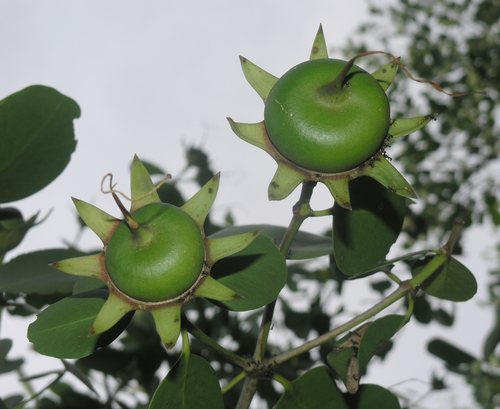
- Thick conical breathing roots; white powder-puff flowers open at night for bats and moths; round green fruit seated on a star-shaped calyx.
- Typical garden-form values; cultivars and local conditions differ.
Reference values for planning, not horticultural, veterinary or medical advice. Varieties, soils and local climates differ: check with a local nursery or extension service.
Related plants
- Pomegranate Punica granatum
- Crepe myrtle Lagerstroemia indica
- Henna Lawsonia inermis
- Queen’s crape myrtle (banaba) Lagerstroemia speciosa
- Mexican heather (false heather) Cuphea hyssopifolia
- Cigar plant Cuphea ignea
- Thai crape myrtle (tabaek) Lagerstroemia floribunda
- Dwarf mountain pine Pinus mugo