Gum arabic tree (hashab, kikwata) Senegalia senegal
Gum arabic tree (hashab, kikwata) (Senegalia senegal) is a deciduous perennial tree in the Fabaceae family, native to Sahel and dry savanna from Senegal to Sudan and Somalia, south to South Africa; also Arabia and north-western India. It grows 2–7 m (6.6–23 ft) tall and 2–6 m (6.6–20 ft) wide, wants full sun and low water, and is hardy to about 0 °C (32 °F). Space plants about 4 m (13 ft) apart.
Plan Gum arabic tree (hashab, kikwata) in your garden →
Free. Draw your beds, then watch it grow through the year in 2D and 3D.
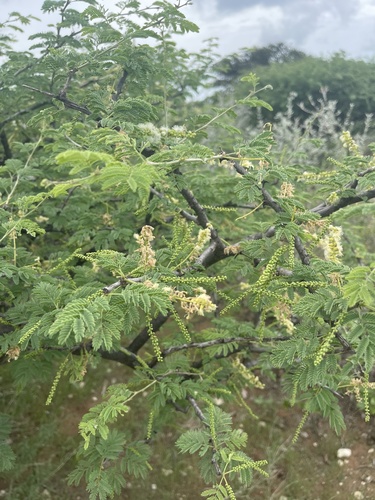
Gum arabic tree (hashab, kikwata) at a glance
| Type | Perennial tree, deciduous |
|---|---|
| Family | Fabaceae |
| Mature height | 2–7 m (6.6–23 ft) |
| Mature spread | 2–6 m (6.6–20 ft) |
| Spacing | 4 m (13 ft) centre to centre |
| Sun | Full sun, at least 8 h of direct sun a day |
| Water | Low; drought tolerance high, waterlogging tolerance none |
| Soil pH | 5–8.5 |
| Cold hardiness | About 0 °C (32 °F) once established (roughly USDA zone 10) |
| Heat stress | Likely above about 46 °C (115 °F) |
| Flowering | from about May for 3–6 weeks (northern hemisphere; later in cold climates, earlier in warm ones) |
| Wind tolerance | Moderate |
| Pollinator value | High |
| Edible | Yes: gum (gum arabic, E414), young pods and seeds (cooked) |
| Native to | Sahel and dry savanna from Senegal to Sudan and Somalia, south to South Africa; also Arabia and north-western India |
| Common in gardens of | 🇳🇬 Nigeria, 🇪🇬 Egypt, 🇰🇪 Kenya, 🇪🇹 Ethiopia, 🇮🇳 India |
Is Gum arabic tree (hashab, kikwata) toxic?
- People: not known to be toxic
- Cats: not known to be toxic
- Dogs: not known to be toxic
Not poisonous; short hooked prickles in threes.
If a child or pet may have eaten part of a plant, call a poison centre or vet straight away.
Companion planting: what to grow with Gum arabic tree (hashab, kikwata)
Good neighbours
- good With Sweet corn: "Three sisters": climbing beans use corn as a support and fix nitrogen; the benefit to the corn is modest but real in low-input soils. Evidence C
Keep apart or take care
- caution With Alliums (onion family): Onions, garlic and leeks are said to stunt beans and peas (allium root exudates may reduce nodulation). Traditional companion-planting advice; controlled trials are few, so treat it as a soft preference. Evidence D
- caution With Alliums (onion family): Beans and peas are traditionally kept away from onions, garlic and leeks. Traditional companion-planting advice; controlled trials are few, so treat it as a soft preference. Evidence D
- caution With Fennel: Fennel is reported to suppress beans and peas growing next to it. Evidence C
Questions about Gum arabic tree (hashab, kikwata)
- How far apart should I plant Gum arabic tree (hashab, kikwata)?
- About 4 m (13 ft) apart, centre to centre. A mature plant spreads 2–6 m (6.6–20 ft).
- Does Gum arabic tree (hashab, kikwata) need full sun?
- Full sun: at least 8 hours of direct sun a day.
- How much water does Gum arabic tree (hashab, kikwata) need?
- Low water. Drought tolerance is high and waterlogging tolerance none.
- How cold-hardy is Gum arabic tree (hashab, kikwata)?
- It tolerates about 0 °C (32 °F) once established, roughly USDA zone 10.
- When does Gum arabic tree (hashab, kikwata) flower?
- From about May for 3–6 weeks (northern hemisphere; later in cold climates, earlier in warm ones).
- Is Gum arabic tree (hashab, kikwata) poisonous to cats and dogs?
- For cats it is not known to be toxic; for dogs not known to be toxic; for people not known to be toxic. Not poisonous; short hooked prickles in threes.
- What grows well with Gum arabic tree (hashab, kikwata)?
- "Three sisters": climbing beans use corn as a support and fix nitrogen; the benefit to the corn is modest but real in low-input soils.
Sources and evidence
Evidence grade A (A: strong evidence).
- Plants of the World Online (taxonomy, native range), Royal Botanic Gardens, Kew
- Agroforestree Database: a tree reference and selection guide, World Agroforestry (CIFOR-ICRAF), Nairobi
- EcoCrop crop environmental requirements, FAO
Notes and assumptions
- A savanna plant of hot summers and a long dry season; it wants sharp drainage and resents cold, wet winters.
- Tappers cut strips of bark in the dry season and pick the amber tears of gum a few weeks later; Sudan’s "gum belt" supplies most of the world’s gum arabic, used in soft drinks, sweets and inks since ancient Egypt. Leafless in the late dry season. Syn. Acacia senegal.
Reference values for planning, not horticultural, veterinary or medical advice. Varieties, soils and local climates differ: check with a local nursery or extension service.
Related plants
- Bush bean Phaseolus vulgaris
- Garden pea Pisum sativum
- Sweet pea Lathyrus odoratus
- Runner bean Phaseolus coccineus
- Broad bean (fava) Vicia faba
- Lima bean Phaseolus lunatus
- Cowpea (black-eyed pea) Vigna unguiculata
- Yardlong bean Vigna unguiculata subsp. sesquipedalis