Canary Islands dragon tree Dracaena draco
Canary Islands dragon tree (Dracaena draco) is an evergreen perennial tree in the Asparagaceae family, native to Canary Islands, Madeira, Cape Verde and Morocco (dry cliffs). It grows 4–12 m (13–39 ft) tall and 3–8 m (10–26 ft) wide, wants full sun and low water, and is hardy to about 0 °C (32 °F). Space plants about 5 m (16 ft) apart.
Plan Canary Islands dragon tree in your garden →
Free. Draw your beds, then watch it grow through the year in 2D and 3D.
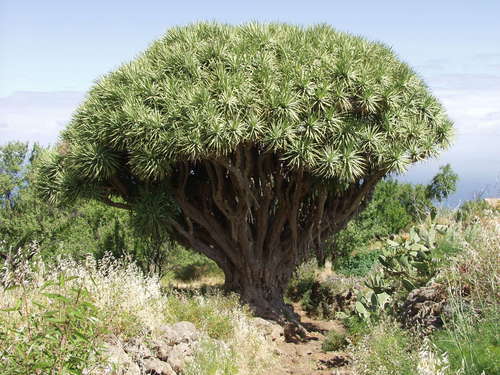
Canary Islands dragon tree at a glance
| Type | Perennial tree, evergreen |
|---|---|
| Family | Asparagaceae |
| Mature height | 4–12 m (13–39 ft) |
| Mature spread | 3–8 m (10–26 ft) |
| Spacing | 5 m (16 ft) centre to centre |
| Sun | Full sun, at least 6 h of direct sun a day |
| Water | Low; drought tolerance high, waterlogging tolerance none |
| Soil pH | 6–8.5 |
| Cold hardiness | About 0 °C (32 °F) once established (roughly USDA zone 10) |
| Heat stress | Likely above about 40 °C (104 °F) |
| Flowering | from about June for 4–9 weeks (northern hemisphere; later in cold climates, earlier in warm ones) |
| Wind tolerance | Moderate |
| Pollinator value | Low |
| Edible | Not grown as food |
| Native to | Canary Islands, Madeira, Cape Verde and Morocco (dry cliffs) |
| Common in gardens of | 🇫🇷 France |
Is Canary Islands dragon tree toxic?
- People: mildly toxic
- Cats: moderately toxic
- Dogs: moderately toxic
- Parts: leaves
Dracaena species contain saponins: vomiting and drooling in cats and dogs (ASPCA).
If a child or pet may have eaten part of a plant, call a poison centre or vet straight away.
Companion planting: what to grow with Canary Islands dragon tree
No well-documented helpful pairing. Group it with plants that like full sun and low water.
See Canary Islands dragon tree in a botanical garden
It grows in these sample gardens, which you can walk through in 3D:
- The Huntington (1 plants)
- Gardens by the Bay (1 plants)
- Kew: glasshouses and rock garden (1 plants)
Questions about Canary Islands dragon tree
- How far apart should I plant Canary Islands dragon tree?
- About 5 m (16 ft) apart, centre to centre. A mature plant spreads 3–8 m (10–26 ft).
- Does Canary Islands dragon tree need full sun?
- Full sun: at least 6 hours of direct sun a day.
- How much water does Canary Islands dragon tree need?
- Low water. Drought tolerance is high and waterlogging tolerance none.
- How cold-hardy is Canary Islands dragon tree?
- It tolerates about 0 °C (32 °F) once established, roughly USDA zone 10.
- When does Canary Islands dragon tree flower?
- From about June for 4–9 weeks (northern hemisphere; later in cold climates, earlier in warm ones).
- Is Canary Islands dragon tree poisonous to cats and dogs?
- For cats it is moderately toxic; for dogs moderately toxic; for people mildly toxic. Dracaena species contain saponins: vomiting and drooling in cats and dogs (ASPCA).
- What grows well with Canary Islands dragon tree?
- There is no well-documented companion pairing for Canary Islands dragon tree. Group it with plants that like the same sun (full sun) and water (low).
Sources and evidence
Evidence grade B (B: extension service or peer-reviewed).
- Plants of the World Online (taxonomy, native range), Royal Botanic Gardens, Kew
- IUCN Red List of Threatened Species, IUCN
- ASPCA Toxic and Non-Toxic Plant List, ASPCA
Notes and assumptions
- Frost-tender to half-hardy: in cold-winter climates it needs a cool glasshouse (as in the Kew Temperate House).
- Branches only after flowering, so the umbrella crown takes decades; red resin is "dragon's blood". Vulnerable in the wild (IUCN).
Reference values for planning, not horticultural, veterinary or medical advice. Varieties, soils and local climates differ: check with a local nursery or extension service.
Related plants
- Asparagus Asparagus officinalis
- Lily of the valley Convallaria majalis
- Hosta Hosta spp.
- Hyacinth Hyacinthus orientalis
- Grape hyacinth Muscari armeniacum
- Common bluebell Hyacinthoides non-scripta
- Tuberose Agave amica (Polianthes tuberosa)
- Century plant (agave) Agave americana