Cardboard palm Zamia furfuracea
Cardboard palm (Zamia furfuracea) is an evergreen perennial shrub in the Zamiaceae family, native to Veracruz, Mexico (coastal dunes). It grows 60 cm–1.2 m (24 in–3.9 ft) tall and 1.2–2 m (3.9–6.6 ft) wide, wants part sun to part shade and low water, and is hardy to about -3 °C (27 °F). Space plants about 1.5 m (4.9 ft) apart.
Plan Cardboard palm in your garden →
Free. Draw your beds, then watch it grow through the year in 2D and 3D.
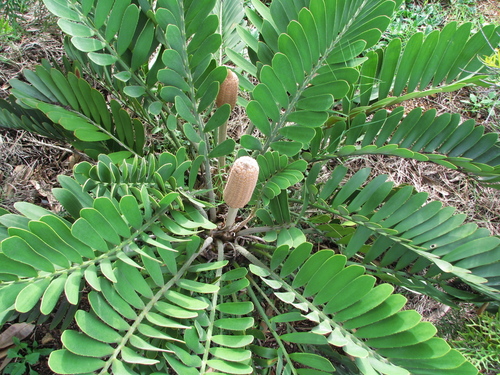
Cardboard palm at a glance
| Type | Perennial shrub, evergreen |
|---|---|
| Family | Zamiaceae |
| Mature height | 60 cm–1.2 m (24 in–3.9 ft) |
| Mature spread | 1.2–2 m (3.9–6.6 ft) |
| Spacing | 1.5 m (4.9 ft) centre to centre |
| Sun | Part sun to part shade, at least 4 h of direct sun a day |
| Water | Low; drought tolerance high, waterlogging tolerance none |
| Soil pH | 6–8.5 |
| Cold hardiness | About -3 °C (27 °F) once established (roughly USDA zone 9) |
| Heat stress | Likely above about 42 °C (108 °F) |
| Flowering | from about May for 4–9 weeks (northern hemisphere; later in cold climates, earlier in warm ones) |
| Wind tolerance | High |
| Pollinator value | None |
| Edible | Not grown as food |
| Native to | Veracruz, Mexico (coastal dunes) |
| Common in gardens of | 🇲🇽 Mexico, 🇺🇸 United States, 🇹🇭 Thailand, 🇸🇬 Singapore |
Is Cardboard palm toxic?
- People: severely toxic
- Cats: severely toxic
- Dogs: severely toxic
- Parts: seeds, all parts
Cycasin: all parts are poisonous, seeds most of all (ASPCA).
If a child or pet may have eaten part of a plant, call a poison centre or vet straight away.
Companion planting: what to grow with Cardboard palm
No well-documented helpful pairing. Group it with plants that like part sun to part shade and low water.
See Cardboard palm in a botanical garden
It grows in these sample gardens, which you can walk through in 3D:
- Nong Nooch Tropical Botanical Garden (8 plants)
- Fairy Lake Botanical Garden (4 plants)
Questions about Cardboard palm
- How far apart should I plant Cardboard palm?
- About 1.5 m (4.9 ft) apart, centre to centre. A mature plant spreads 1.2–2 m (3.9–6.6 ft).
- Does Cardboard palm need full sun?
- Part sun to part shade: at least 4 hours of direct sun a day.
- How much water does Cardboard palm need?
- Low water. Drought tolerance is high and waterlogging tolerance none.
- How cold-hardy is Cardboard palm?
- It tolerates about -3 °C (27 °F) once established, roughly USDA zone 9.
- When does Cardboard palm flower?
- From about May for 4–9 weeks (northern hemisphere; later in cold climates, earlier in warm ones).
- Is Cardboard palm poisonous to cats and dogs?
- For cats it is severely toxic; for dogs severely toxic; for people severely toxic. Cycasin: all parts are poisonous, seeds most of all (ASPCA).
- What grows well with Cardboard palm?
- There is no well-documented companion pairing for Cardboard palm. Group it with plants that like the same sun (part sun to part shade) and water (low).
Sources and evidence
Evidence grade B (B: extension service or peer-reviewed).
- Plants of the World Online (taxonomy, native range), Royal Botanic Gardens, Kew
- ASPCA Toxic and Non-Toxic Plant List, ASPCA
- UF/IFAS Extension tropical and subtropical fruit and landscape publications, University of Florida
Notes and assumptions
- Stiff, felted, cardboard-like leaflets; salt-tolerant. Not a palm but a cycad. Vulnerable in the wild.
Reference values for planning, not horticultural, veterinary or medical advice. Varieties, soils and local climates differ: check with a local nursery or extension service.
Related plants
- Eastern Cape giant cycad Encephalartos altensteinii
- Wood's cycad Encephalartos woodii
- Karoo cycad Encephalartos lehmannii
- Burrawang (cycad) Macrozamia communis
- Bigleaf hydrangea Hydrangea macrophylla
- Rhododendron Rhododendron
- Boxwood Buxus sempervirens
- Oleander Nerium oleander