Camphor tree Cinnamomum camphora
Camphor tree (Cinnamomum camphora) is an evergreen perennial tree in the Lauraceae family, native to South China, Taiwan, Japan and Korea. It grows 15–30 m (49–98 ft) tall and 15–30 m (49–98 ft) wide, wants full sun and moderate water, and is hardy to about -8 °C (18 °F). Space plants about 15 m (49 ft) apart.
Plan Camphor tree in your garden →
Free. Draw your beds, then watch it grow through the year in 2D and 3D.
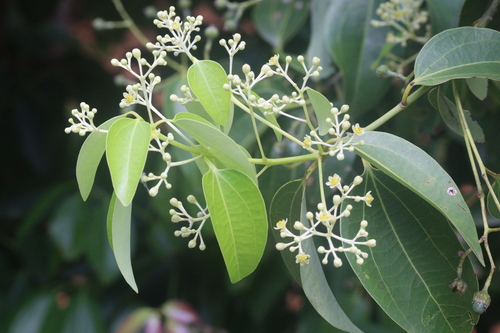
Camphor tree at a glance
| Type | Perennial tree, evergreen |
|---|---|
| Family | Lauraceae |
| Mature height | 15–30 m (49–98 ft) |
| Mature spread | 15–30 m (49–98 ft) |
| Spacing | 15 m (49 ft) centre to centre |
| Sun | Full sun, at least 5 h of direct sun a day |
| Water | Moderate; drought tolerance moderate, waterlogging tolerance low |
| Soil pH | 5–7.5 |
| Cold hardiness | About -8 °C (18 °F) once established (roughly USDA zone 8) |
| Heat stress | Likely above about 40 °C (104 °F) |
| Flowering | from about April for 3–4 weeks (northern hemisphere; later in cold climates, earlier in warm ones) |
| Wind tolerance | Moderate |
| Pollinator value | Moderate |
| Edible | Not grown as food |
| Native to | South China, Taiwan, Japan and Korea |
| Common in gardens of | 🇨🇳 China, 🇯🇵 Japan, 🇿🇦 South Africa, 🇦🇺 Australia |
| Invasive in | Australia (Queensland, NSW), Florida, South Africa: check local rules before planting |
Is Camphor tree toxic?
- People: moderately toxic
- Cats: moderately toxic
- Dogs: moderately toxic
- Parts: leaves, berries
Camphor oil causes seizures if eaten.
If a child or pet may have eaten part of a plant, call a poison centre or vet straight away.
Companion planting: what to grow with Camphor tree
No well-documented helpful pairing. Group it with plants that like full sun and moderate water.
Keep apart or take care
- caution With Avocado: Laurel wilt (Raffaelea lauricola), carried by redbay ambrosia beetles, kills avocado and wild laurels such as redbay and sassafras in the south-eastern US. Evidence B
See Camphor tree in a botanical garden
It grows in these sample gardens, which you can walk through in 3D:
- The Huntington (1 plants)
- Fairy Lake Botanical Garden (4 plants)
- Kirstenbosch (10 plants)
Questions about Camphor tree
- How far apart should I plant Camphor tree?
- About 15 m (49 ft) apart, centre to centre. A mature plant spreads 15–30 m (49–98 ft).
- Does Camphor tree need full sun?
- Full sun: at least 5 hours of direct sun a day.
- How much water does Camphor tree need?
- Moderate water. Drought tolerance is moderate and waterlogging tolerance low.
- How cold-hardy is Camphor tree?
- It tolerates about -8 °C (18 °F) once established, roughly USDA zone 8.
- When does Camphor tree flower?
- From about April for 3–4 weeks (northern hemisphere; later in cold climates, earlier in warm ones).
- Is Camphor tree poisonous to cats and dogs?
- For cats it is moderately toxic; for dogs moderately toxic; for people moderately toxic. Camphor oil causes seizures if eaten.
- What grows well with Camphor tree?
- There is no well-documented companion pairing for Camphor tree. Group it with plants that like the same sun (full sun) and water (moderate).
Sources and evidence
Evidence grade B (B: extension service or peer-reviewed).
- Flora of China, Missouri Botanical Garden & Harvard University Herbaria (eFloras)
- Plants of the World Online (taxonomy, native range), Royal Botanic Gardens, Kew
- CABI Invasive Species Compendium, CABI
Notes and assumptions
- Huge spreading evergreen with glossy, camphor-scented leaves that flush red in spring; shrine trees in Japan exceed 1,000 years. Kirstenbosch has a camphor avenue planted by Cecil Rhodes in 1898.
Reference values for planning, not horticultural, veterinary or medical advice. Varieties, soils and local climates differ: check with a local nursery or extension service.
Related plants
- Bay laurel Laurus nobilis
- Avocado Persea americana
- Northern spicebush Lindera benzoin
- Ceylon cinnamon Cinnamomum verum
- Cassia (Chinese cinnamon) Cinnamomum cassia
- Sassafras Sassafras albidum
- California bay (Oregon myrtle) Umbellularia californica
- Peumo (Chilean acorn tree) Cryptocarya alba