Blue water lily (blue lotus of Egypt) Nymphaea nouchali var. caerulea
Blue water lily (blue lotus of Egypt) (Nymphaea nouchali var. caerulea) is an evergreen perennial flowering plant in the Nymphaeaceae family, native to Nile valley and tropical/southern Africa. It grows 10–30 cm (4–12 in) tall and 1.2–2.2 m (3.9–7.2 ft) wide, wants full sun and high water, and is hardy to about 10 °C (50 °F). Space plants about 1.5 m (4.9 ft) apart.
Plan Blue water lily (blue lotus of Egypt) in your garden →
Free. Draw your beds, then watch it grow through the year in 2D and 3D.
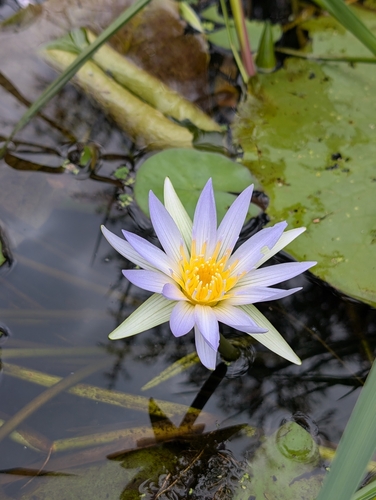
Blue water lily (blue lotus of Egypt) at a glance
| Type | Perennial flowering plant, evergreen |
|---|---|
| Family | Nymphaeaceae |
| Mature height | 10–30 cm (4–12 in) |
| Mature spread | 1.2–2.2 m (3.9–7.2 ft) |
| Spacing | 1.5 m (4.9 ft) centre to centre |
| Sun | Full sun, at least 6 h of direct sun a day |
| Water | High; drought tolerance none, waterlogging tolerance high |
| Soil pH | 6–8 |
| Cold hardiness | About 10 °C (50 °F) once established (roughly USDA zone 12) |
| Heat stress | Likely above about 38 °C (100 °F) |
| Flowering | from about March for 21–43 weeks (northern hemisphere; later in cold climates, earlier in warm ones) |
| Wind tolerance | Low |
| Pollinator value | Moderate |
| Edible | Not grown as food |
| Native to | Nile valley and tropical/southern Africa |
| Common in gardens of | 🇹🇭 Thailand, 🇸🇬 Singapore, 🇿🇦 South Africa, 🇧🇷 Brazil, 🇪🇬 Egypt |
Is Blue water lily (blue lotus of Egypt) toxic?
- People: mildly toxic
- Cats: not well documented
- Dogs: not well documented
- Parts: flowers
Contains aporphine alkaloids (apomorphine); not for eating.
If a child or pet may have eaten part of a plant, call a poison centre or vet straight away.
Companion planting: what to grow with Blue water lily (blue lotus of Egypt)
No well-documented helpful pairing. Group it with plants that like full sun and high water.
See Blue water lily (blue lotus of Egypt) in a botanical garden
It grows in these sample gardens, which you can walk through in 3D:
- The Huntington (4 plants)
- Singapore Botanic Gardens (6 plants)
- Gardens by the Bay (8 plants)
- Brooklyn Botanic Garden (3 plants)
- China National Botanical Garden (2 plants)
- Nong Nooch Tropical Botanical Garden (8 plants)
- Fairy Lake Botanical Garden (6 plants)
- Missouri Botanical Garden (5 plants)
- Jardim Botânico do Rio de Janeiro (6 plants)
- Denver Botanic Gardens (4 plants)
- Na ʻĀina Kai Botanical Gardens (6 plants)
- New York Botanical Garden (2 plants)
Questions about Blue water lily (blue lotus of Egypt)
- How far apart should I plant Blue water lily (blue lotus of Egypt)?
- About 1.5 m (4.9 ft) apart, centre to centre. A mature plant spreads 1.2–2.2 m (3.9–7.2 ft).
- Does Blue water lily (blue lotus of Egypt) need full sun?
- Full sun: at least 6 hours of direct sun a day.
- How much water does Blue water lily (blue lotus of Egypt) need?
- High water. Drought tolerance is none and waterlogging tolerance high.
- How cold-hardy is Blue water lily (blue lotus of Egypt)?
- It tolerates about 10 °C (50 °F) once established, roughly USDA zone 12.
- When does Blue water lily (blue lotus of Egypt) flower?
- From about March for 21–43 weeks (northern hemisphere; later in cold climates, earlier in warm ones).
- Is Blue water lily (blue lotus of Egypt) poisonous to cats and dogs?
- For cats it is not well documented; for dogs not well documented; for people mildly toxic. Contains aporphine alkaloids (apomorphine); not for eating.
- What grows well with Blue water lily (blue lotus of Egypt)?
- There is no well-documented companion pairing for Blue water lily (blue lotus of Egypt). Group it with plants that like the same sun (full sun) and water (high).
Sources and evidence
Evidence grade B (B: extension service or peer-reviewed).
- Water lily and lotus registry and cultivation notes, International Waterlily & Water Gardening Society
- Plants of the World Online (taxonomy, native range), Royal Botanic Gardens, Kew
Notes and assumptions
- Grown in a pond: rhizome or tuber in a basket of heavy loam at the stated depth; needs full sun and still water.
- Tropical: in cool climates it is grown as an annual or overwintered in a heated pool (as in glasshouse lily ponds).
- Tropical day-blooming lilies hold their star-shaped flowers above the water.
Reference values for planning, not horticultural, veterinary or medical advice. Varieties, soils and local climates differ: check with a local nursery or extension service.
Related plants
- European white water lily Nymphaea alba
- Hardy water lily (Marliac hybrids) Nymphaea × marliacea
- Fragrant water lily Nymphaea odorata
- White Egyptian lotus (tiger lotus) Nymphaea lotus
- Giant Amazon water lily Victoria amazonica
- Santa Cruz water lily Victoria cruziana
- Yellow pond lily (brandy bottle) Nuphar lutea
- Sunflower Helianthus annuus