Ashanti pepper (West African black pepper, uziza) Piper guineense
Ashanti pepper (West African black pepper, uziza) (Piper guineense) is an evergreen perennial herb in the Piperaceae family, native to Tropical Africa (Guinea to Uganda and Angola). It grows 3–15 m (10–49 ft) tall and 1–2 m (3.3–6.6 ft) wide, wants shade and high water, and is hardy to about 12 °C (54 °F). Space plants about 1.5 m (4.9 ft) apart.
Plan Ashanti pepper (West African black pepper, uziza) in your garden →
Free. Draw your beds, then watch it grow through the year in 2D and 3D.
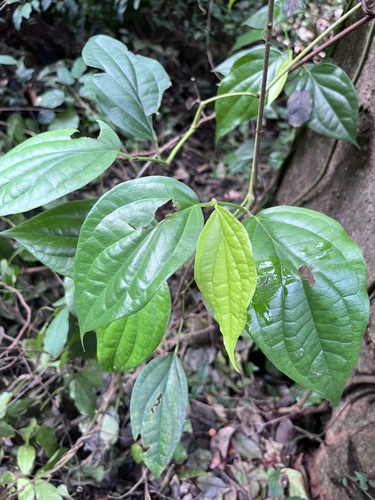
Ashanti pepper (West African black pepper, uziza) at a glance
| Type | Perennial herb, evergreen |
|---|---|
| Family | Piperaceae |
| Mature height | 3–15 m (10–49 ft) |
| Mature spread | 1–2 m (3.3–6.6 ft) |
| Spacing | 1.5 m (4.9 ft) centre to centre |
| Sun | Shade, at least 2 h of direct sun a day |
| Water | High; drought tolerance none, waterlogging tolerance low |
| Soil pH | 5–6.5 |
| Cold hardiness | About 12 °C (54 °F) once established (roughly USDA zone 12) |
| Heat stress | Likely above about 34 °C (93 °F) |
| Flowering | about 104–156 weeks after planting, for 9–17 weeks |
| Wind tolerance | None |
| Pollinator value | Low |
| Edible | Yes: berries (spice), leaves (uziza leaves in soups) |
| Native to | Tropical Africa (Guinea to Uganda and Angola) |
| Common in gardens of | 🇳🇬 Nigeria |
Is Ashanti pepper (West African black pepper, uziza) toxic?
- People: not known to be toxic
- Cats: not known to be toxic
- Dogs: not known to be toxic
Not poisonous; used as a spice.
If a child or pet may have eaten part of a plant, call a poison centre or vet straight away.
Companion planting: what to grow with Ashanti pepper (West African black pepper, uziza)
No well-documented helpful pairing. Group it with plants that like shade and high water.
Questions about Ashanti pepper (West African black pepper, uziza)
- How far apart should I plant Ashanti pepper (West African black pepper, uziza)?
- About 1.5 m (4.9 ft) apart, centre to centre. A mature plant spreads 1–2 m (3.3–6.6 ft).
- Does Ashanti pepper (West African black pepper, uziza) need full sun?
- Shade: at least 2 hours of direct sun a day.
- How much water does Ashanti pepper (West African black pepper, uziza) need?
- High water. Drought tolerance is none and waterlogging tolerance low.
- How cold-hardy is Ashanti pepper (West African black pepper, uziza)?
- It tolerates about 12 °C (54 °F) once established, roughly USDA zone 12.
- When does Ashanti pepper (West African black pepper, uziza) flower?
- About 104–156 weeks after planting, for 9–17 weeks.
- Is Ashanti pepper (West African black pepper, uziza) poisonous to cats and dogs?
- For cats it is not known to be toxic; for dogs not known to be toxic; for people not known to be toxic. Not poisonous; used as a spice.
- What grows well with Ashanti pepper (West African black pepper, uziza)?
- There is no well-documented companion pairing for Ashanti pepper (West African black pepper, uziza). Group it with plants that like the same sun (shade) and water (high).
Sources and evidence
Evidence grade B (B: extension service or peer-reviewed).
- Plants of the World Online (taxonomy, native range), Royal Botanic Gardens, Kew
- PROTA4U: Plant Resources of Tropical Africa, PROTA Foundation, Wageningen
Notes and assumptions
- Tropical: needs warm nights all year; in a frosty climate grow it under glass or as a summer container plant.
- A climbing pepper that roots onto forest trees; in south-eastern Nigeria it is trained up trees in the home garden for its spicy leaves. The berries are milder and more perfumed than Asian black pepper.
Reference values for planning, not horticultural, veterinary or medical advice. Varieties, soils and local climates differ: check with a local nursery or extension service.
Related plants
- Black pepper Piper nigrum
- Betel leaf Piper betle
- Lolot (wild betel) Piper sarmentosum
- Kawakawa Piper excelsum
- Baby rubber plant (blunt-leaved peperomia) Peperomia obtusifolia
- Emerald ripple peperomia Peperomia caperata
- Basil Ocimum basilicum
- Rosemary Salvia rosmarinus