White api-api Avicennia alba
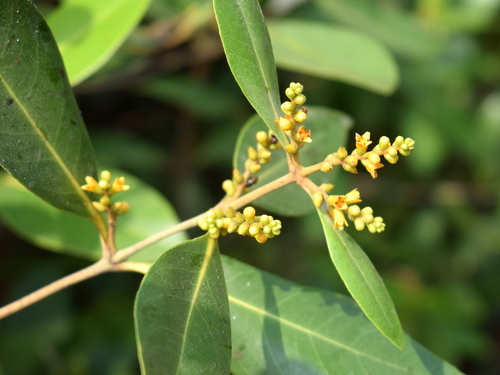
White api-api (Avicennia alba) is an evergreen perennial tree in the Acanthaceae family, native to South and Southeast Asia to New Guinea and northern Australia, including Singapore (pioneer on the seaward mudflats). It grows 8–20 m (26–66 ft) tall and 5–10 m (16–33 ft) wide, wants full sun and high water, and is hardy to about 10 °C (50 °F). Space plants about 5 m (16 ft) apart.
Plan White api-api in your garden →
Free. Draw your beds, then watch it grow through the year in 2D and 3D.
White api-api at a glance
| Type | Perennial tree, evergreen |
|---|---|
| Family | Acanthaceae |
| Mature height | 8–20 m (26–66 ft) |
| Mature spread | 5–10 m (16–33 ft) |
| Spacing | 5 m (16 ft) centre to centre |
| Sun | Full sun, at least 6 h of direct sun a day |
| Water | High; drought tolerance low, waterlogging tolerance high |
| Soil pH | 5.5–8.5 |
| Cold hardiness | About 10 °C (50 °F) once established (roughly USDA zone 12) |
| Heat stress | Likely above about 40 °C (104 °F) |
| Flowering | from about April for 9–17 weeks (northern hemisphere; later in cold climates, earlier in warm ones) |
| Wind tolerance | High |
| Pollinator value | Moderate |
| Edible | Not grown as food |
| Native to | South and Southeast Asia to New Guinea and northern Australia, including Singapore (pioneer on the seaward mudflats) |
| Common in gardens of | 🇸🇬 Singapore, 🇹🇭 Thailand, 🇦🇺 Australia |
Is White api-api toxic?
- People: not known to be toxic
- Cats: not known to be toxic
- Dogs: not known to be toxic
No toxicity reported in ASPCA or standard poison references.
If a child or pet may have eaten part of a plant, call a poison centre or vet straight away.
Companion planting: what to grow with White api-api
No well-documented helpful pairing. Group it with plants that like full sun and high water.
See White api-api in a botanical garden
It grows in this sample garden, which you can walk through in 3D:
- Gardens by the Bay (5 plants)
Questions about White api-api
- How far apart should I plant White api-api?
- About 5 m (16 ft) apart, centre to centre. A mature plant spreads 5–10 m (16–33 ft).
- Does White api-api need full sun?
- Full sun: at least 6 hours of direct sun a day.
- How much water does White api-api need?
- High water. Drought tolerance is low and waterlogging tolerance high.
- How cold-hardy is White api-api?
- It tolerates about 10 °C (50 °F) once established, roughly USDA zone 12.
- When does White api-api flower?
- From about April for 9–17 weeks (northern hemisphere; later in cold climates, earlier in warm ones).
- Is White api-api poisonous to cats and dogs?
- For cats it is not known to be toxic; for dogs not known to be toxic; for people not known to be toxic. No toxicity reported in ASPCA or standard poison references.
- What grows well with White api-api?
- There is no well-documented companion pairing for White api-api. Group it with plants that like the same sun (full sun) and water (high).
Sources and evidence
Evidence grade B (B: extension service or peer-reviewed).
- Flora & Fauna Web, National Parks Board, Singapore
- Mangrove plants of Singapore (fact sheets; after Ng & Sivasothi, A Guide to the Mangroves of Singapore), WildSingapore
- Sungei Buloh Wetland Reserve: mangrove flora and boardwalks, National Parks Board, Singapore
Notes and assumptions
- Mangrove: grows in tidal, saline mud flooded by brackish water; it is a coastal habitat plant, not for ordinary garden soil.
- Pencil-like breathing roots (pneumatophores) stick up from the mud in thousands around the tree; leaves excrete salt and are pale grey beneath.
- Typical garden-form values; cultivars and local conditions differ.
Reference values for planning, not horticultural, veterinary or medical advice. Varieties, soils and local climates differ: check with a local nursery or extension service.
Related plants
- Black-eyed Susan vine Thunbergia alata
- Firecracker flower (crossandra) Crossandra infundibuliformis
- Bear’s breeches Acanthus mollis
- Bengal clock vine (blue trumpet vine) Thunbergia grandiflora
- Mexican petunia (Britton’s wild petunia) Ruellia simplex
- Nerve plant (fittonia) Fittonia albivenis
- Dwarf mountain pine Pinus mugo
- Japanese maple Acer palmatum