African tulip tree (Nandi flame) Spathodea campanulata
African tulip tree (Nandi flame) (Spathodea campanulata) is an evergreen perennial tree in the Bignoniaceae family, native to Tropical African forests. It grows 10–25 m (33–82 ft) tall and 7–12 m (23–39 ft) wide, wants full sun and moderate water, and is hardy to about 5 °C (41 °F). Space plants about 10 m (33 ft) apart.
Plan African tulip tree (Nandi flame) in your garden →
Free. Draw your beds, then watch it grow through the year in 2D and 3D.
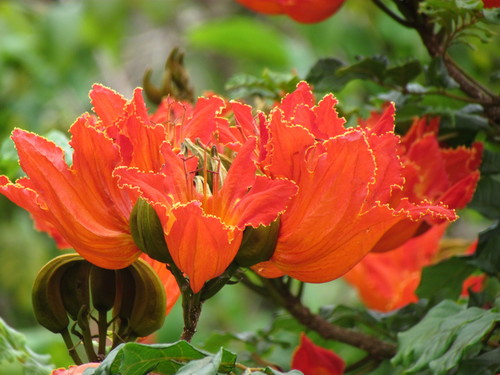
African tulip tree (Nandi flame) at a glance
| Type | Perennial tree, evergreen |
|---|---|
| Family | Bignoniaceae |
| Mature height | 10–25 m (33–82 ft) |
| Mature spread | 7–12 m (23–39 ft) |
| Spacing | 10 m (33 ft) centre to centre |
| Sun | Full sun, at least 6 h of direct sun a day |
| Water | Moderate; drought tolerance moderate, waterlogging tolerance low |
| Soil pH | 5–7.5 |
| Cold hardiness | About 5 °C (41 °F) once established (roughly USDA zone 11) |
| Heat stress | Likely above about 40 °C (104 °F) |
| Flowering | about 156–261 weeks after planting, for 13–26 weeks |
| Wind tolerance | Low |
| Pollinator value | High |
| Edible | Not grown as food |
| Native to | Tropical African forests |
| Common in gardens of | 🇰🇪 Kenya, 🇳🇬 Nigeria, 🇪🇹 Ethiopia, 🇸🇬 Singapore, 🇹🇭 Thailand, 🇧🇷 Brazil |
| Invasive in | Hawaii, Pacific islands, Queensland: check local rules before planting |
Is African tulip tree (Nandi flame) toxic?
- People: mildly toxic
- Cats: mildly toxic
- Dogs: mildly toxic
- Parts: flowers, seeds
Flower nectar is reported to harm stingless bees; seeds mildly toxic.
If a child or pet may have eaten part of a plant, call a poison centre or vet straight away.
Companion planting: what to grow with African tulip tree (Nandi flame)
No well-documented helpful pairing. Group it with plants that like full sun and moderate water.
Questions about African tulip tree (Nandi flame)
- How far apart should I plant African tulip tree (Nandi flame)?
- About 10 m (33 ft) apart, centre to centre. A mature plant spreads 7–12 m (23–39 ft).
- Does African tulip tree (Nandi flame) need full sun?
- Full sun: at least 6 hours of direct sun a day.
- How much water does African tulip tree (Nandi flame) need?
- Moderate water. Drought tolerance is moderate and waterlogging tolerance low.
- How cold-hardy is African tulip tree (Nandi flame)?
- It tolerates about 5 °C (41 °F) once established, roughly USDA zone 11.
- When does African tulip tree (Nandi flame) flower?
- About 156–261 weeks after planting, for 13–26 weeks.
- Is African tulip tree (Nandi flame) poisonous to cats and dogs?
- For cats it is mildly toxic; for dogs mildly toxic; for people mildly toxic. Flower nectar is reported to harm stingless bees; seeds mildly toxic.
- What grows well with African tulip tree (Nandi flame)?
- There is no well-documented companion pairing for African tulip tree (Nandi flame). Group it with plants that like the same sun (full sun) and water (moderate).
Sources and evidence
Evidence grade B (B: extension service or peer-reviewed).
- CABI Invasive Species Compendium, CABI
- Flora & Fauna Web, National Parks Board, Singapore
Notes and assumptions
- Brilliant orange-red flowers; one of the world’s most planted ornamental trees and an invasive in the Pacific.
Reference values for planning, not horticultural, veterinary or medical advice. Varieties, soils and local climates differ: check with a local nursery or extension service.
Related plants
- Cape honeysuckle Tecoma capensis
- Trumpet vine Campsis radicans
- Jacaranda Jacaranda mimosifolia
- Pink trumpet tree (ipê) Handroanthus impetiginosus
- Nile tulip (markhamia) Markhamia lutea
- Desert willow Chilopsis linearis
- Indian bean tree (southern catalpa) Catalpa bignonioides
- Rosy trumpet tree (chomphu phanthip) Tabebuia rosea